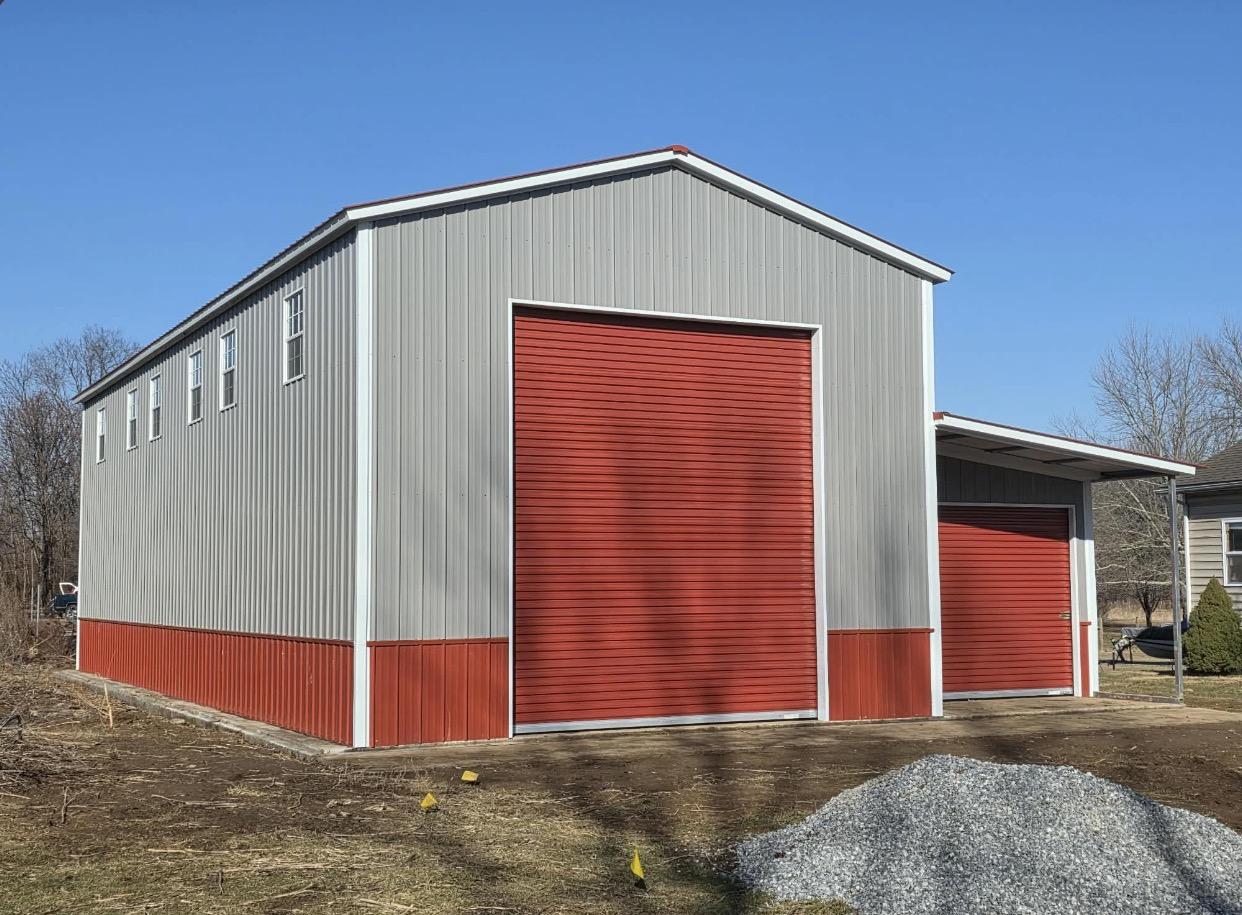
Farms run on dry storage. Hay that stays dry keeps its value. Equipment kept under a roof lasts longer and starts easier. Animals need a place out of the wind. A steel barn handles all of that, and it does not need painting, does not rot, and does not give termites anything to eat.
We are a family-run metal building and concrete contractor in Southwest Virginia, and a lot of our customers are farmers and landowners. We handle site review, site prep, foundations, and the building install, so you are not coordinating three different crews during a busy season.
Common Farm Uses
- Hay and feed storage
- Tractor, implement, and equipment storage
- Livestock shelter and run-in sheds
- Workshop space for repairs
- Combined storage with a lean-to on one or both sides
If you are not sure how big to go, think about the largest implement you own and the one you might buy next. Our size guide includes notes on tractors and equipment.
Barn Styles
Center Building With Lean-Tos
A popular layout is a taller center section with lower lean-tos on the sides. The center holds tall equipment or hay, and the sides cover smaller equipment or give animals a sheltered area. Lean-tos can be open or enclosed. See lean-tos and add-ons.
Fully Enclosed Barn
Four walls, roll-up doors, walk-in doors, and windows as needed. Good for equipment you want locked up and out of blowing rain.
Open-Sided Shelter
Roof and frame with some or all sides open. Good for hay and run-in shelter where airflow matters. Keep in mind open carport-style structures are not eligible for rent-to-own.
Roof Style
Most barns we put up have a vertical roof. Panels run peak to eave, so rain and snow shed off fast, which matters a lot on bigger roofs. Boxed-eave and regular roofs are available too, mostly where cost matters more than snow shedding.
Floors: Dirt, Gravel, or Concrete
Not every barn needs a slab. Many ag buildings sit on compacted ground or gravel, especially where animals will be. Equipment and shop areas often benefit from concrete. We pour footers below local frost depth and can pour a typical 4-inch slab where you want it. Concrete is quoted separately from the building. More on our concrete foundations page.
Hay and Condensation
Steel roofs can collect condensation when warm, moist air hits cold metal. In a hay barn, drips are the last thing you want. Ask about insulation or a condensation barrier, and plan for good airflow. Our building care page has more on ventilation.
Permits and Ag Exemptions
Some counties treat farm buildings differently than residential ones, and some offer agricultural exemptions. The rules vary a lot, so ask your county directly before you assume anything. Our permit help page has a list of questions to bring. Our buildings can be certified for local wind and snow loads, and engineered drawings are available if needed.
Paying for Your Barn
Enclosed barns qualify for our rent-to-own program: 15 percent down, 90 days same as cash starting at delivery. If you are planning ahead for next season, a 15 percent deposit locks your quoted building price until spring.
Why Farmers Trust Us
We only work with 4 vetted manufacturers, after cutting ties with 53 others over quality and integrity concerns. On a farm, a building has to hold up. We are not going to sell you something we would not put on our own land.
Let’s Talk About Your Barn
Tell us what you need to store and how you farm. Use the quote builder or call or text 276-235-1191, and we will help you plan a barn that works for your operation.
Common Questions
Does a metal barn need a concrete floor?
Not always. Many barns sit on compacted ground or gravel, especially for livestock. Equipment and shop areas often benefit from a slab. We can pour concrete where you want it, quoted separately.
Can I add lean-tos to a barn?
Yes. A center building with lean-tos on one or both sides is a common farm layout. Lean-tos can be open or enclosed.
Do farm buildings need a permit?
It depends on your county. Some offer agricultural exemptions and some do not. Ask your county building and zoning office before you build.
How do I keep a hay barn from dripping?
Condensation forms when warm, moist air meets cold steel. Insulation or a condensation barrier plus good airflow helps. Ask us to include it in your quote.
Ready to price your building?
Call or text 276-235-1191, or send us the size, location and what it is for. We will come back with a real number.