Metal building scams are common enough that every buyer should verify a seller before sending money. Before you pay anything, pause the transaction, verify the business through public records and the Better Business Bureau, and refuse any seller who insists on wire transfers, gift cards, or payment apps. The FBI’s IC3 and FTC both track this fraud pattern closely, and companies can build processes to reduce these risks for buyers.
TL;DR:
- Confirm the seller’s active state registration, check its BBB profile and complaint history, and call independently verified local references before signing.
- Use a credit card or escrow for early payments, tie larger sums to delivery or installation milestones, and require itemized written refund terms.
- Compare quotes for steel gauge, freight, foundation, permits, engineering, and installation; a low headline price may omit costly essentials that belong in the contract.
- If the seller changes terms or misses written deadlines, object in writing, refuse extra fees to speed work, and keep every contract and message.
- Before installation, verify the crew’s liability and workers’ compensation coverage, who will obtain required permits, and the installer’s metal building experience.
Table of Contents
- What Metal Building Scams Look Like
- Red Flags That Signal a Risky Quote or Seller
- How to Verify a Metal Building Seller Before You Sign
- Payment and Contract Terms That Protect You
- What to Do If You Suspect You Have Been Scammed
- Why Rock-Bottom Quotes Usually Hide Missing Items
- What a Reputable Builder Does Differently to Protect Buyers
- How to Inspect a Metal Building in Person Before You Buy
- After-Sale Tactics Scammers Use and How to Respond
- Verifying Installer Qualifications Before You Commit
- A Note on Transparency From Our Team
- Ready to Request a Straight Quote?
- FAQ
- Sources
What Metal Building Scams Look Like
Most metal building fraud follows a handful of repeatable scripts. Telemarketers call with a rock-bottom price and claim steel prices are about to spike, pressuring you to lock in the deal today with a deposit. Others pitch a “leftover” or “cancelled” building, supposedly already built and ready to ship at a discount, if you pay a nonrefundable deposit right away.
A more damaging version is the vanishing-deposit model: a seller collects a deposit, strings you along with excuses, then disappears. A related scheme uses fake-check overpayment, where a buyer is asked to deposit a check and wire back the difference before the bank discovers the check is fraudulent, a tactic the FTC has documented extensively.
- Telemarketing pitches that demand an immediate “price lock” deposit.
- “Leftover” or “cancelled” building offers requiring fast nonrefundable payment.
- Fake-check schemes asking you to wire back overpaid funds.
- Business email compromise, where fraudsters impersonate suppliers or officials to redirect payments, a pattern outlined in IC3’s business email compromise advisory.
Red Flags That Signal a Risky Quote or Seller
A few warning signs show up again and again in complaints about metal building sellers. Watch for these before you ever discuss payment.
- No verifiable headquarters, or an address shared by several unrelated businesses, often a sign of a virtual office or mailbox service.
- High-pressure tactics: urgent deadlines, “today only” pricing, or insistence on a large nonrefundable deposit before you have seen a written contract.
- Payment requests limited to wire transfer, cryptocurrency, gift cards, or payment apps, methods the FTC specifically warns against because they are nearly impossible to reverse.
- A vague scope of work, no mention of engineering or permits, or a “starting at” price with no list of what is actually included.
Pro Tip: If a seller refuses to put the price, inclusions, and timeline in writing before asking for money, treat that as a closed conversation.
How to Verify a Metal Building Seller Before You Sign
A little research upfront catches most fraud before it starts. Run the company name through your state’s corporation or business-license search to confirm it is a registered, active entity. Check the Better Business Bureau profile and search the company name alongside words like “scam,” “lawsuit,” or “attorney general” to surface complaints that would not show up on the seller’s own website.
Ask for engineer-stamped drawings, anchor and foundation details, and photos or addresses of recent local installs, then call those references yourself rather than trusting a list handed to you. Our own guide to vetting a metal building company walks through this process in more detail.
- Confirm active business registration through your state’s corporate search tool.
- Check BBB ratings and search for complaint patterns online.
- Request engineer-stamped drawings and verify recent local references independently.
- Call the phone number and visit the physical address yourself, or visit a showroom in person when one exists.
Payment and Contract Terms That Protect You
The safest deals tie payment to progress, not to a seller’s promises. A reasonable deposit covers design and material ordering, with the balance due at delivery or completion milestones, never the bulk of the price collected upfront. Paying by credit card gives you dispute rights that a wire transfer or gift card does not.
Your contract should spell out exactly what is included (materials, gauge of steel, labor, freight), who handles permits and engineering, the delivery and install schedule, and the refund or termination terms if something falls through. A verbal promise means nothing once a dispute starts, so keep a signed copy of every document and every email.
- Pay by credit card or an escrow arrangement for early sums whenever the seller allows it.
- Tie larger payments to manufacturing completion, delivery, or install milestones instead of one upfront sum.
- Require an itemized contract listing inclusions, permit responsibility, and refund terms.
- Keep copies of every contract, email, and receipt in one place.
Pro Tip: Never sign a contract with blank fields, even if the seller promises to “fill it in later.”
What to Do If You Suspect You Have Been Scammed
Act fast if something feels wrong. Contact your bank or card issuer immediately to ask about reversing the payment, since credit card disputes have a limited window. File reports with local police, your state attorney general, the Better Business Bureau, and the FBI’s Internet Crime Complaint Center, which tracks exactly this kind of scheme.
- Contact your bank or card issuer right away to request a reversal.
- File a report with local police and your state attorney general’s office.
- Submit a complaint to IC3 and the FTC, and notify the BBB.
- Save every contract, text, email, photo, and receipt, and write down a timeline of what happened.
Why Rock-Bottom Quotes Usually Hide Missing Items
A price that looks too good almost always leaves something out. The line items that drive real cost include the gauge of steel, freight to your site, engineered drawings, the foundation or concrete pad, permit fees, and installation labor. Our breakdown of what affects metal building pricing covers these factors in depth.
Typical lead times run from order to install over several weeks depending on custom size and season, and some delay is normal when materials or weather cause a shift. Repeated, vague excuses with no new delivery date are a different problem entirely.
- Check whether the quote states the steel gauge, not just the building size.
- Confirm freight, foundation, permits, and installation labor are itemized, not bundled into a single vague line.
- Ask directly what is not included, and get the answer in writing.
What a Reputable Builder Does Differently to Protect Buyers
A trustworthy seller gives you a straight, itemized quote before asking for a deposit, not after. We handle site prep, concrete, and installation in-house with one point of contact from the first conversation through final walkthrough, which means no finger-pointing between subcontractors if something goes wrong.
- Transparent, itemized quotes before any deposit is requested.
- Turnkey installation with in-house site prep and concrete work.
- Engineer-backed drawings and local references you can call.
- One point of contact accountable from quote to finished build.
Some builders only work with manufacturers they trust, and may turn down jobs that do not meet quality standards rather than cut corners to win the sale.
How to Inspect a Metal Building in Person Before You Buy
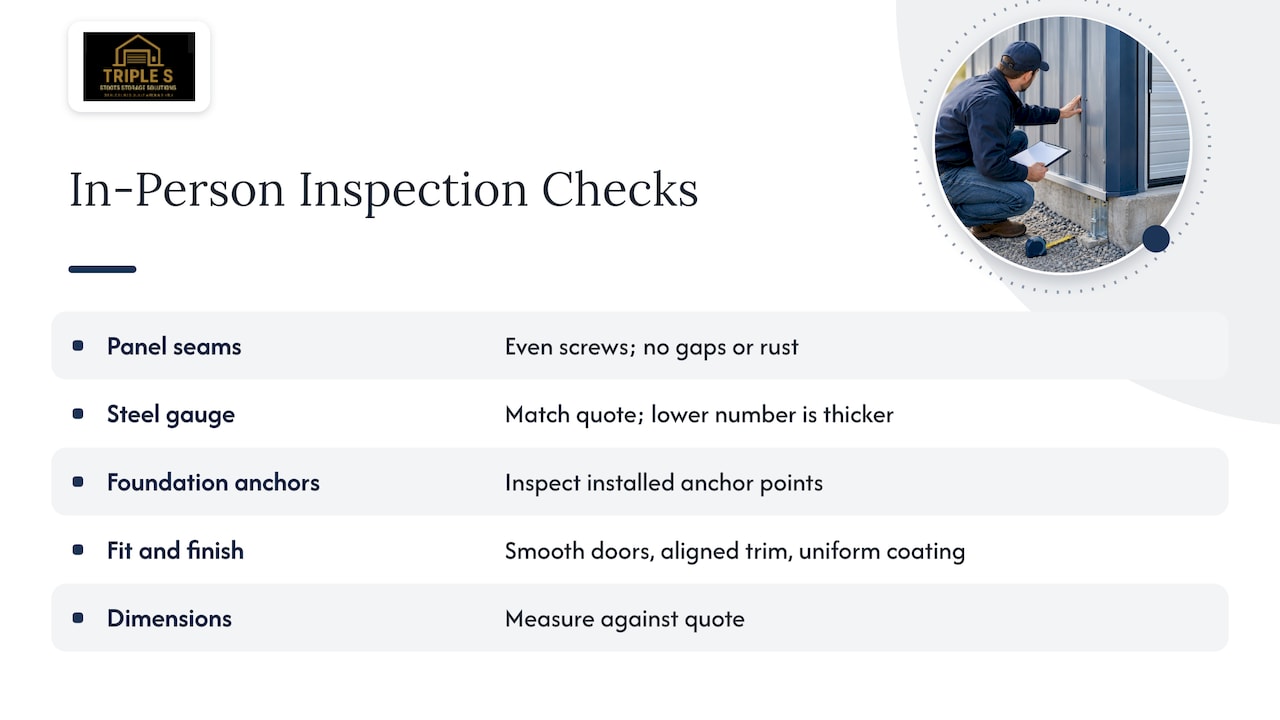
A site visit tells you more than any brochure. If the seller has a showroom or a local install you can see, walk the structure and check the seams where panels meet for even, tight screw patterns rather than gaps or rust streaks starting early. Run a hand along the trim and flashing; loose or missing trim pieces often signal rushed work.
Check the gauge of steel against what the contract promised. Thicker gauge steel has a lower number (14-gauge is sturdier than 29-gauge), and a seller using a thinner panel than quoted is a common way to quietly cut costs. Ask to see the foundation or anchor points if the building is already installed, since anchoring quality affects how well a structure holds up in wind.
Look at the overall fit and finish: doors should open and close smoothly, trim should line up at the corners, and paint or coating should look uniform without obvious touch-ups. If a seller cannot show you a finished local project or photos with verifiable addresses, ask why. Our gallery of completed installs exists specifically so buyers can see real finished work before committing.
Bring a tape measure if you can, and compare actual dimensions to what the quote specifies. A legitimate builder will not mind you checking.
After-Sale Tactics Scammers Use and How to Respond
The scam does not always end at the deposit. Some sellers change the scope after payment, suddenly adding fees for items that were supposedly included, or claim the original steel gauge or size is “no longer available” and substitute something cheaper. Others simply delay the installation repeatedly, offering a new excuse each time you call, until you give up asking.
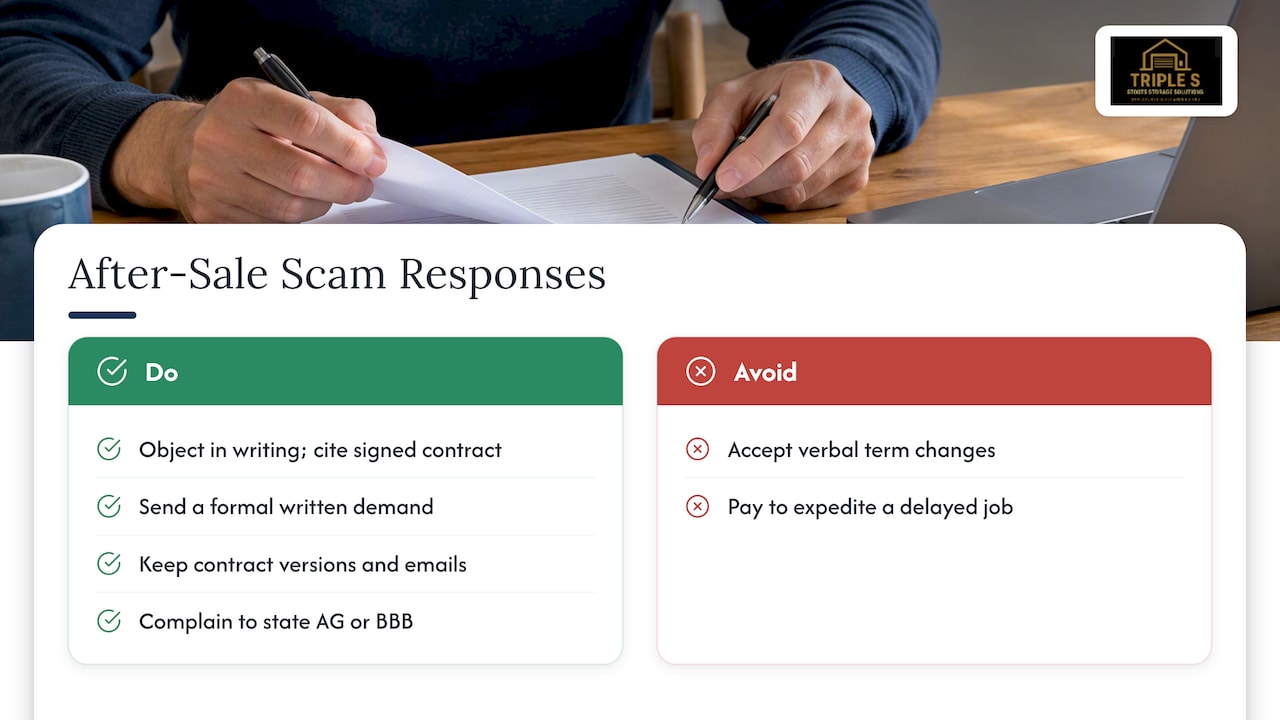
If a seller tries to change contract terms after you have paid, put your objection in writing immediately and reference the original signed contract. Do not agree to a verbal modification, and do not send additional money to “expedite” a delayed job, since that is itself a common pressure tactic. If delays stretch well beyond the original written timeline with no documented reason, treat that as cause to escalate, starting with a formal written demand and, if needed, a complaint to your state attorney general or the BBB.
Keep every version of the contract and every email exchange so you have a clear record if you need to dispute a charge or file a complaint later.
Verifying Installer Qualifications Before You Commit
The person swinging the wrench matters as much as the company on the invoice. Ask whether the installation crew works directly for the company or is subcontracted, and ask for proof of liability insurance and workers’ compensation coverage before anyone sets foot on your property. A legitimate installer should have no issue providing certificates of insurance on request.
Confirm whether local permits require a licensed contractor for your specific structure, since requirements vary by project type and jurisdiction; our partner guide on permit triggers for home projects walks through how permit requirements typically get triggered, which is a useful comparison when you are asking your metal building seller the same kind of questions. Ask who pulls the permit, who is listed as the responsible party, and get that in writing.
Finally, ask how long the installation crew has worked specifically with metal buildings, not just construction in general. Anchoring, panel alignment, and trim work on a metal structure differ from wood-frame construction, and an installer unfamiliar with the specifics is more likely to leave gaps that cause leaks or structural issues later.
A Note on Transparency From Our Team
We are a family-owned shop, and we built our process around removing the guesswork buyers face elsewhere: itemized quotes before any deposit, turnkey installs, and one point of contact from start to finish. Use the checklist above with any seller you consider, and reach out if you want a second set of eyes on a quote.
— Stoots
Ready to Request a Straight Quote?
We put every inclusion, engineering detail, and timeline in writing before asking for a deposit, so you know exactly what you are paying for.
- Browse our garages, carports, barns, and barndominium shells to see current options.
- View our gallery of real customer installs to see finished work before you commit.
Reach out through our home page to request a quote or schedule an in-person consultation.
FAQ
What are some of the most common metal building scams right now?
Common patterns include telemarketers pressuring buyers to lock in a price due to supposed steel shortages, “leftover” or cancelled-building offers that demand a fast nonrefundable deposit, and fake-check overpayment schemes where you are asked to wire back funds before a bad check bounces. The FTC and FBI’s IC3 both track these patterns closely.
How do construction scams typically work?
Most construction scams follow a similar structure: a seller collects a deposit or full payment upfront, then delays, changes terms, or disappears entirely before finishing the work. A recent case saw a metal building company owner sentenced to 14 years after taking deposits and failing to deliver buildings to customers.
What payment methods should I avoid when buying a metal building?
Avoid sellers who insist on wire transfers, cryptocurrency, gift cards, or payment apps, since these methods are difficult or impossible to reverse once sent. The FTC recommends paying by credit card when possible, since it gives you dispute rights a wire transfer does not.
How can I check if a metal building company is legitimate?
Search your state’s business registration database to confirm the company is active and properly licensed, then check its Better Business Bureau profile and search the company name with terms like “scam” or “lawsuit.” Ask for engineer-stamped drawings and call recent local references yourself instead of relying on a list the seller provides.
What should I do if I think I have already been scammed?
Contact your bank or card issuer immediately to ask about reversing the payment, then file reports with local police, your state attorney general, and the FBI’s Internet Crime Complaint Center. Save every contract, email, photo, and receipt, since documentation strengthens any dispute or investigation.
Sources
- IC3 Public Service Announcement – 2026 PSA260309
- Way to spot scams: how someone asks you to pay | FTC Consumer Alerts
- Bullock sentenced to 14 years in prison – Riverbend News
Leave a Reply