Most homeowners pay between $1,100 and $1,700 for a professionally installed gravel pad, with a national average around $1,400, though larger or more complex jobs can climb higher. Pad size, base depth, and how much site prep your lot needs are the three factors that move that number the most. Material-only DIY costs run much lower, but they skip the labor, compaction equipment, and grading that keep a pad stable under a shed or garage for years.
TL;DR:
- Each extra inch of base depth adds about $1 to $4 per square foot, and difficult access or grading can push complex installations to $2,400.
- Recycled concrete is cheapest at $10 to $20 per ton; road base costs $15 to $25, while delivery adds $50 to $150.
- DIY suits light sheds on firm ground that drains well, but garages or poor soil favor professionals; proper compaction requires 90% to 95% density.
- Require quotes to itemize aggregate type and tonnage, delivery, excavation, fabric, edging, and cleanup, and ask whether crews use a vibratory roller.
Table of Contents
- Typical Costs for Common Shed and Garage Pad Sizes
- What Drives the Price: Materials, Labor, and Site Prep
- Per-Ton Pricing and Converting Pad Size to Material Needs
- DIY Cost Estimate vs Hiring a Professional
- Step-by-Step Estimator You Can Reuse
- What a Complete Quote Should Include
- A Site-Prep Perspective on Durable Gravel Pads
- FAQ
- Sources
Typical Costs for Common Shed and Garage Pad Sizes
The bigger the footprint, the more material and labor you’re paying for, but thickness matters just as much as square footage. Base-depth needs vary with the structure, site conditions, and intended use, affecting the pad’s ability to handle vehicle weight and prevent shifting.
Here’s what the size ranges typically look like for professionally installed pads:
- An 8×10 pad (80 square feet) usually falls at the low end of the $1,100 to $1,700 range, since it needs the least material and labor time.
- A 10×12 pad (120 square feet) sits in the middle of that range for most straightforward sites.
- A 12×16 pad (192 square feet) pushes toward the upper half of the typical range, especially when a deeper base is needed.
- A 12×20 pad (240 square feet) often lands near or above $1,700, particularly for garage-grade thickness.
Each additional inch of depth beyond a standard base typically adds another $1 to $4 per square foot, since you’re paying for more material, more delivery weight, and more compaction passes. Sites with tight equipment access, steep grading, or heavy brush and debris removal can push any of these pads above the listed ranges, sometimes as high as $2,400 for the most complex jobs.
What Drives the Price: Materials, Labor, and Site Prep
A gravel pad quote is really several line items stacked together, and understanding each one helps you spot where a bid is reasonable and where it’s padded. Material type is the first variable: well-graded crusher run or road base compacts into a solid foundation, while decorative loose gravel looks nice but shifts under weight and isn’t suited for structural use.
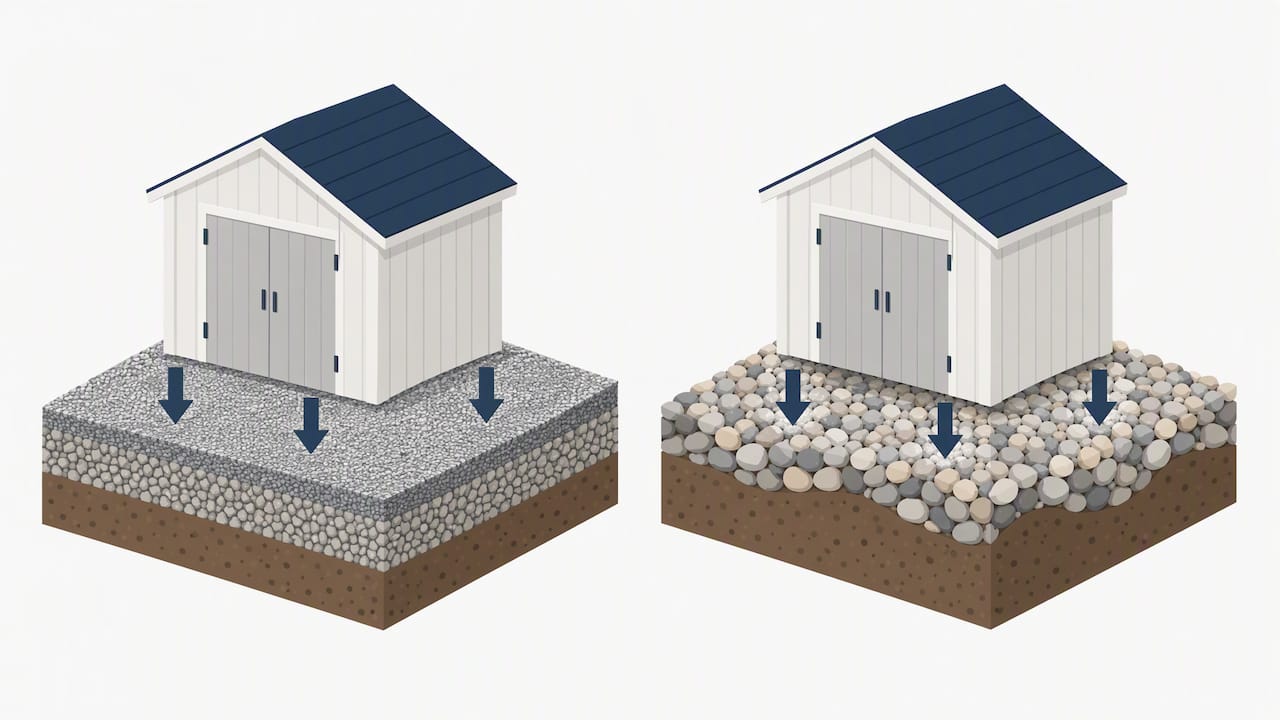
Proximity to a quarry can swing material costs by 10 to 30 percent, since delivery distance affects both the price per ton and the logistics of getting a load to your site. Rural lots near a gravel supplier often pay less than urban sites that require tighter scheduling and longer hauls.
Other cost drivers worth knowing:
- Site clearing and debris removal can add to the cost depending on how much brush, old flooring, or uneven ground needs addressing.
- Geotextile fabric and edging materials add to the bill but prevent weeds from pushing through and keep gravel from migrating outward over time.
- Equipment choice matters too: a rented plate compactor costs less than hiring a crew with a vibratory roller, but it also delivers a lower-quality result.
Per-Ton Pricing and Converting Pad Size to Material Needs
Once you know your pad dimensions, the math to estimate material cost is straightforward. Standard gravel road base typically runs $15 to $25 per ton, crushed stone runs $25 to $40 per ton, and recycled concrete aggregate comes in cheaper at $10 to $20 per ton. Premium decorative materials can reach $50 per ton. Delivery typically adds another $50 to $150 depending on distance and load size, and small residential orders sometimes hit a supplier’s minimum charge regardless of tonnage.
| Material | Price per ton |
|---|---|
| Recycled concrete aggregate | $10 to $20 |
| Gravel road base | $15 to $25 |
| Crushed stone | $25 to $40 |
| Premium decorative gravel | up to $50 |
To convert your pad into material quantities:
- Multiply length by width to get square footage, then multiply by depth in inches and divide by 324 to get cubic yards.
- Convert cubic yards to tons using your supplier’s density figure, since gravel weight varies by material type.
- Multiply total tons by the per-ton price for your chosen material, then add delivery.
For a 10×12 pad (120 square feet) at 6 inches deep: 120 × 6 ÷ 324 equals about 2.2 cubic yards. At standard road base pricing, that’s a modest material cost before delivery and labor are added.
DIY Cost Estimate vs Hiring a Professional
Material-only DIY costs typically run $4 to $10 per square foot, a fraction of the fully installed price, but that number doesn’t include the equipment or technique needed to get a pad to hold up long term. You’ll need a plate compactor, a wheelbarrow, a level, and timbers or edging material at minimum.
The catch is compaction. Reaching proper density for a non-structural pad requires 90 to 95 percent of standard proctor density, and that typically means a vibratory roller and a multi-lift approach rather than a single pass. Small rented plate compactors often only compact the top 1 to 2 inches, leaving the base vulnerable to settling.
- DIY tends to make sense for light-use sheds on firm, well-drained soil with easy equipment access.
- Hiring a pro makes more sense for garage pads, poor soils, heavy storage loads, or sites where a warranty on workmanship matters.
- Professional pricing models vary, but look for either an hourly rate or a clear per-square-foot range in the quote.
Pro Tip: Squeeze a handful of base material before compacting it. It should hold its shape without crumbling or dripping water, which signals the right moisture content for a dense, stable base.
Step-by-Step Estimator You Can Reuse
Running your own numbers before you call a contractor makes it much easier to tell whether a quote is fair. Here’s the sequence:
- Measure your pad’s length and width in feet, then choose a finished depth suited to the structure and site.
- Calculate cubic yards using area in square feet times depth in inches, divided by 324.
- Convert cubic yards to tons using your supplier’s density conversion, then multiply by the per-ton price for your chosen material.
- Add delivery charges, edging and fabric costs, and labor to reach your installed estimate.
For a 10×12 pad at 6 inches, you land at roughly 2.2 cubic yards of material. At typical road base pricing, the material cost alone is modest, but once delivery, fabric, edging, and compaction labor are folded in, the fully installed total typically falls within the broader $1,100 to $1,700 range most homeowners report for a project this size. Running this math against any quote you receive is the fastest way to spot whether a bid is in line with typical pricing or inflated.
What a Complete Quote Should Include
A clear quote protects you from surprise charges after the work starts. Before you sign anything, make sure the bid itemizes:
- Excavation and haul-away of existing soil, sod, or debris.
- Material type and total tonnage, not just a flat “gravel” line item.
- Geotextile fabric type and edging materials.
- Compaction method and target density, ideally 90 to 95 percent standard proctor.
- Delivery fees and any minimum-order charges for small pads.
- Final cleanup and grading.
Ask directly what equipment the crew uses for compaction, since a vibratory roller produces a denser, longer-lasting base than hand tools alone. For a straightforward site with good access, installation may take less time than a more complex project. Extra time gets added when the site needs significant clearing, grading corrections, or multiple compaction lifts for a deeper garage-grade base.
A Site-Prep Perspective on Durable Gravel Pads
The gravel pads that hold up longest aren’t necessarily the ones with the fanciest material. They’re the ones where depth, compaction, and drainage were planned correctly from the start rather than patched together on site. We’ve found that an itemized quote with clear compaction specs saves more money over time than chasing the lowest bid. Readers who want the fuller checklist can look at our site prep guide.
— Stoots
FAQ
How much is 10 yards of gravel delivered?
The cost depends heavily on material type and delivery distance, since gravel road base runs $15 to $25 per ton while crushed stone runs higher, and delivery itself adds $50 to $150 on top of material costs. The delivered cost depends on the material’s weight and delivery distance, and excludes installation labor.
What are the steps involved in building a gravel shed pad?
A proper gravel pad starts with clearing the site and leveling the ground, then laying geotextile fabric to block weeds and separate soil from the base layer. From there, aggregate goes down in multiple lifts, with each layer compacted separately to reach proper density rather than compacting the full depth at once.
Is road base better than gravel?
Road base and crushed stone materials compact into a dense, stable surface that holds up under structural weight, while loose decorative gravel shifts more easily and isn’t designed for that purpose. For a shed or garage pad, a well-graded base material is the better structural choice.
What is the cheapest type of gravel?
Recycled concrete aggregate is typically the least expensive option, running $10 to $20 per ton, compared to standard gravel road base or crushed stone. Pricing still varies by region and proximity to a supplier.
Sources
- How Much Does a Gravel Pad for a Shed Cost? 2026 Data | Angi
- Gravel Base Price (2026 Cost Guide) | Hello Gravel
- Construction of Equine All-Weather Paddocks for Mud-Free Management
Leave a Reply