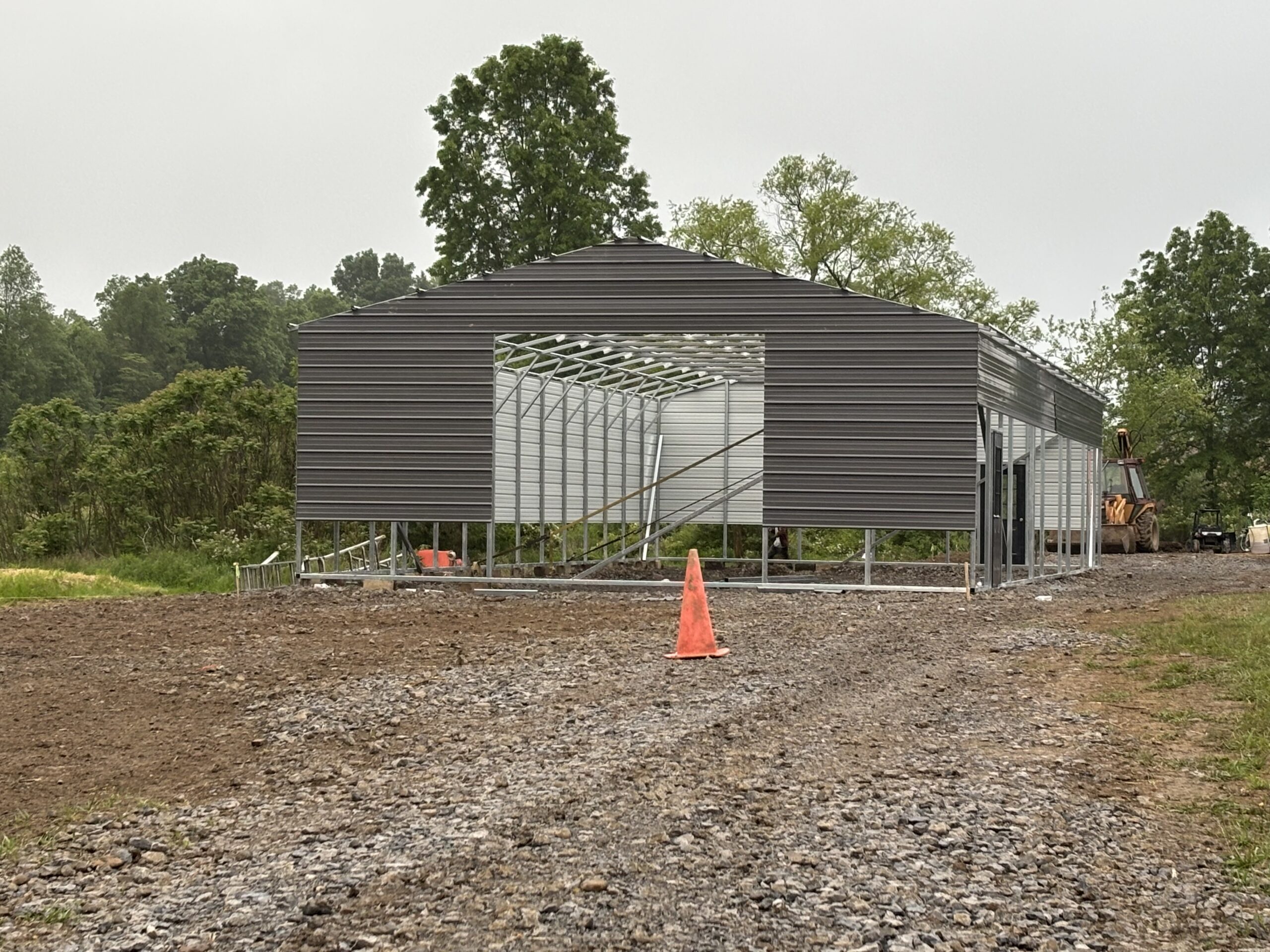
Most of the time, you cannot use Section 179 to write off the full cost of a new metal garage, shop or barn. The IRS treats a standard building as real property, and real property is generally depreciated over decades, not expensed in year one. There are real exceptions, though: certain single-purpose agricultural structures, some interior improvements, and equipment that goes inside the building. Bonus depreciation can also change the math. This guide walks through each one so you can walk into your CPA’s office with the right questions.
We build, deliver and install metal buildings, and we are not tax advisors. Treat this as a map, then confirm the details for your return with a CPA or enrolled agent.
TL;DR
- A standard metal building (garage, shop, storage barn) is generally a building, so it does not qualify for Section 179 expensing on its own.
- Single-purpose livestock or horticultural structures, and certain non-building storage like grain bins, are the main exceptions, and they depend on how the structure is used.
- For 2026 the Section 179 limit is $2,560,000, and 100% bonus depreciation applies to qualifying property acquired after January 19, 2025.
- Section 179 is an election you make on Form 4562, and it cannot exceed your business income for the year.
- Some states, Kentucky for one, do not follow the federal rules, so ask about your state return too.
Table of Contents
- Why a metal building usually does not qualify
- What can qualify
- A quick reference table
- The 2026 numbers
- Bonus depreciation: the other tool
- The income limit most buyers miss
- It is an election, not an automatic break
- Do not buy for the tax break alone
- Your state may not follow the federal rules
- Our perspective: plan the project first, then the paperwork
- How to prepare before you order
- Ag and commercial projects: where we see the most questions
- Get a quote your accountant can work with
- FAQ
- Sources
Why a metal building usually does not qualify
Section 179 lets a business deduct the cost of qualifying property in the year it is placed in service instead of spreading it over several years. The catch is the word “qualifying.” Under IRS Publication 946, eligible property is mostly tangible personal property such as machinery and equipment, plus a short list of specific real property improvements.
A prefabricated steel garage, a shop, or a barn shell sits on a foundation and is permanently attached to the land. For tax purposes that makes it a building and its structural components. Buildings are not on the Section 179 list, whether they are made of wood, block or steel. The fact that the structure is metal, pre-engineered or fast to erect does not change the classification.
This is the most common point of confusion for people searching this topic. Equipment dealers and finance pages often say “Section 179 covers business assets,” and buyers assume a building is an asset like a tractor. It is an asset, but it falls into a different tax category.
What can qualify
The useful question is not “does a metal building qualify?” but “which part of this project qualifies, and for what use?”
Single-purpose agricultural structures
The Farmer’s Tax Guide (Publication 225) lists single-purpose agricultural (livestock) or horticultural structures among the kinds of property eligible for the Section 179 deduction. Think of a structure designed and used for one job only, such as housing livestock or growing plants. A general-purpose pole barn where you park a tractor, store hay one season and keep tools the next is a very different thing, and it should not be assumed to qualify.
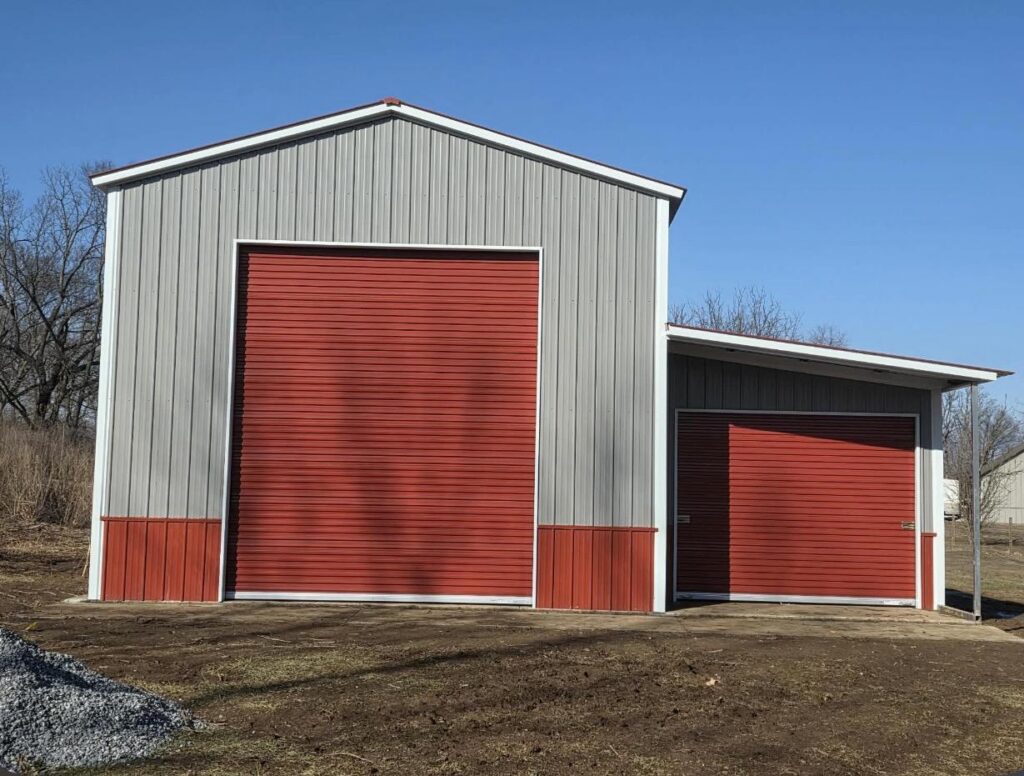
The lesson from the IRS guidance is that use matters as much as construction. If you are a farmer planning a livestock building, the design, the intended use and the paperwork all need to line up with the definition. Your CPA will want to see that.
Storage that is not a building
Grain bins and silos are the classic examples of agricultural storage that tax professionals often treat differently from a building. If your plan involves that kind of structure, raise it with your preparer early.
Improvements to an existing nonresidential building
The IRS allows a Section 179 election for certain improvements to nonresidential real property. Topic no. 704 names roofs, HVAC systems, fire protection and alarm systems, and security systems, when they are placed in service after the building was first placed in service. In practice, that can matter if you already own a commercial building and are replacing or adding these components. It does not turn a brand-new building shell into Section 179 property.
Equipment you put inside
A workshop with a new lift, a welding setup, a CNC table or shop machinery may offer Section 179 or bonus depreciation on the equipment even when the building itself does not qualify. Keep the invoices for the building and the equipment separate so your preparer can allocate cleanly.
A quick reference table
| Item | Typical Section 179 treatment | Ask your CPA about |
|---|---|---|
| Standard metal garage, shop or storage building | Generally not eligible | Regular depreciation for nonresidential real property |
| Single-purpose livestock or horticultural structure | May be eligible | How the structure is designed and used |
| Grain bin or silo | Often treated as non-building storage | Classification before purchase |
| Roof, HVAC, fire or security system added to an existing nonresidential building | May qualify as qualified real property | Placed-in-service date of the original building |
| Shop equipment, lifts, compressors | Often eligible as equipment | Business-use percentage |
| Barndominium or any living space | Residential property rules apply | Personal use and any business portion |
This table is a starting point, not a ruling. Facts decide each case.
The 2026 numbers
For tax years beginning in 2025, Publication 946 puts the maximum Section 179 deduction at $2,500,000, reduced dollar for dollar once total qualifying property placed in service exceeds $4,000,000. For 2026, one 2026 guide citing Rev. Proc. 2025-32 reports a limit of $2,560,000, with the phase-out starting at $4,090,000 and ending at $6,650,000.
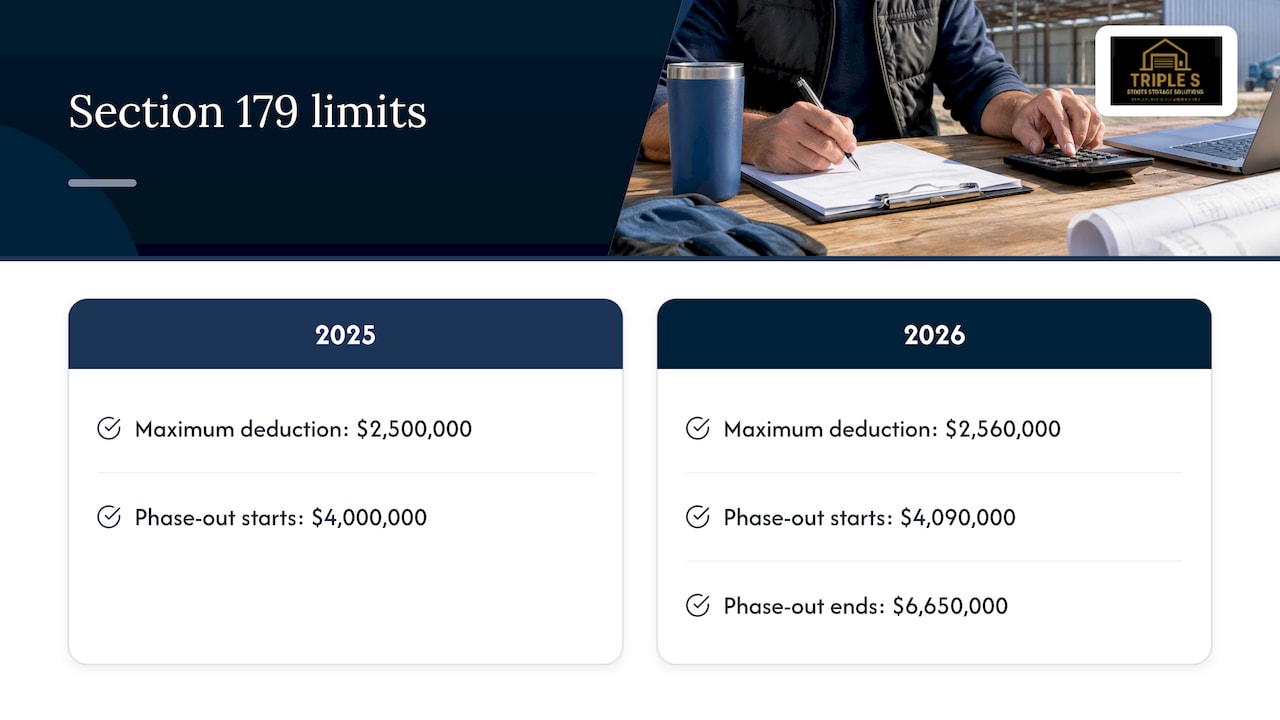
Those limits are far above what most homeowners, small farms and small shops spend on a building. The limit is rarely the issue. Eligibility and income are.
Bonus depreciation: the other tool
Section 179 is not the only way to speed up a deduction. The IRS says the additional first-year (bonus) depreciation allowance is 100% for qualified property acquired and placed in service after January 19, 2025. It is taken after any allowable Section 179 deduction.
Bonus depreciation also applies only to qualified property, which generally means property with a recovery period of 20 years or less. A building classified as nonresidential real property has a much longer recovery period, so it does not ride along. That is why the building itself is usually the hard part, and the equipment, vehicles and certain land improvements are the easier wins. Which land improvements qualify depends on the facts, so ask your preparer about site work specifically instead of assuming.
The income limit most buyers miss
Even when part of a purchase qualifies, the deduction is capped at the taxable income from your active trade or business for the year. Publication 946 explains that the excess can generally be carried forward, but you get no benefit this year for the amount over the cap.
Here is a plain example with invented numbers. A small fabrication shop expects $60,000 of taxable business income and buys $90,000 of qualifying equipment. The Section 179 deduction would be limited by that income, and the rest would be carried forward or handled through other depreciation. Your own result depends on your return, so use your preparer’s numbers, not ours.
It is an election, not an automatic break
Buying something does not trigger the deduction. You choose it on Form 4562 and attach it to your return for the year the property was placed in service. Placed in service means ready and available for its intended use, not the day you signed a contract or paid a deposit. For a building, that usually means after it is erected and usable, and that timing is worth planning around if you are buying close to December 31.
Keep the contract, invoices, delivery and completion dates, and a short written note of what the building is used for. If you are a farmer, add photos and a description of the use.
Do not buy for the tax break alone
Tax professionals consistently warn against over-investing to chase a deduction. The deduction reduces your tax bill, but it does not refund the spending. IRS Topic no. 704 describes the limits tied to business income, and a large purchase in a low-income year can leave you with a cash drain and little immediate relief.
A better test: would you buy this building, this size, this year without the deduction? If yes, any tax benefit is a bonus. If no, slow down.
Your state may not follow the federal rules
Federal rules are only half the picture. Kentucky is a good example, and we serve customers there. According to the Kentucky Department of Revenue’s Form 720 instructions, Kentucky limits the Section 179 deduction to $100,000 for property placed in service on or after January 1, 2020, and disallows federal bonus depreciation. That means two depreciation schedules, one for the federal return and one for the state return.
Other states have their own conformity rules, and they change. Ask your preparer how your state handles Section 179 and bonus depreciation before you rely on the federal number.
Our perspective: plan the project first, then the paperwork
We are a family-owned company in Galax, VA, and we handle site prep, concrete and installation in-house with one point of contact. Customers come to us for garages, workshops, carports, barns and barndominium shells. A fair number ask whether the whole thing can be written off.
Our honest answer is that it depends, and often the answer for the building itself is no. We would rather you hear that from us before you sign than find out in March. What we can do is give you a clear, itemized quote so your CPA can see what is a building, what is site work, what is concrete and what is an add-on. The cleaner the paperwork, the easier your preparer’s job.
We also turn down work when quality standards cannot be met, and we give straight answers and transparent quotes before any deposit. That applies to tax talk too: we will not promise a deduction we cannot back up, and we will not push a bigger building because of a year-end deadline. Buy the size you need. A building that fits the job pays for itself in use, not in a tax line.
— Stoots
How to prepare before you order
- Define the use in writing. Livestock housing, equipment storage, a client-facing shop, hay storage and a personal garage are all different tax stories.
- Ask your CPA to classify it. Bring a sketch, the intended use and a rough budget. Ask specifically whether it is a building, a single-purpose agricultural structure or something else.
- Request an itemized quote. Ask for separate lines for the building, concrete and foundation, site preparation, doors and add-ons, so each piece can be assessed on its own.
- Check your income picture. Confirm your expected business income for the year so the income limit does not surprise you.
- Plan the placed-in-service date. Allow for permitting, site prep, delivery and installation if you want it in service by a given tax year-end. Our permit help page explains what to expect, and our guide on permits for metal buildings in Virginia covers the local side.
- Confirm state rules. Ask whether your state follows the federal treatment.
Ag and commercial projects: where we see the most questions
Farmers tend to have the most to gain from careful classification. If you are weighing a metal barn or agricultural building, think about whether it will serve one purpose or several, and whether you want flexibility more than a particular tax label. A hay barn also has its own safety demands, which we cover in our hay storage barn design guide.
Small business owners looking at a shop, warehouse or storage facility should look at our commercial metal buildings page, and plan equipment purchases next to the building purchase. If you are adding to an existing structure, our lean-tos and add-ons may suit the job. For anyone building a home-and-shop combination, what a barndominium shell includes is worth reading, since living space follows residential rules.
Get a quote your accountant can work with
If you are planning a garage, workshop, barn or commercial building, we can quote the building, concrete, site prep and installation as clear separate items. Browse our metal buildings, look at our concrete and foundation services, or start at stootsstorage.com to tell us what you are building. Pricing is not published online, so request a quote and we will send straight numbers before any deposit is required.
FAQ
Can you take a Section 179 deduction on a building?
Generally no. Buildings and their structural components are not Section 179 property. The exceptions are specific: certain single-purpose agricultural structures and qualified improvements such as roofs, HVAC, fire protection and security systems on existing nonresidential buildings. Have your CPA confirm how your project is classified.
Does a metal barn count as an agricultural structure for Section 179?
Only if it fits the definition of a single-purpose agricultural or horticultural structure, such as one built and used solely for livestock or plants. A general-purpose barn used for storage, equipment and hay does not automatically qualify. The IRS Farmer’s Tax Guide is the place to start, and your preparer should make the call.
Can I deduct the equipment I put in my new shop?
Often yes, if the equipment qualifies as Section 179 property and you use it for business. Form 4562 instructions describe property acquired by purchase for use in the active conduct of a trade or business. Keep equipment invoices separate from building costs.
Is there a deadline to buy and place a building in service?
The deduction applies to the tax year in which property is placed in service, so the date the building is finished and usable matters more than the signing date. Permits, site work and delivery can push that date later than you expect, so start early in the year if timing matters.
Does my state allow Section 179 and bonus depreciation?
Not always. Kentucky, for example, limits Section 179 to $100,000 and disallows federal bonus depreciation for property placed in service on or after January 1, 2020. Check your own state’s revenue department or ask your preparer.
Sources
- IRS Publication 946, How To Depreciate Property
- IRS Publication 225, Farmer’s Tax Guide
- IRS Topic no. 704, Depreciation
- IRS, Depreciation and recapture FAQ
- IRS, About Form 4562
- IRS, Instructions for Form 4562 (2025)
- Kentucky Department of Revenue, Form 720 Instructions
- Section 179 and Depreciation 2026 guide (Jupid)