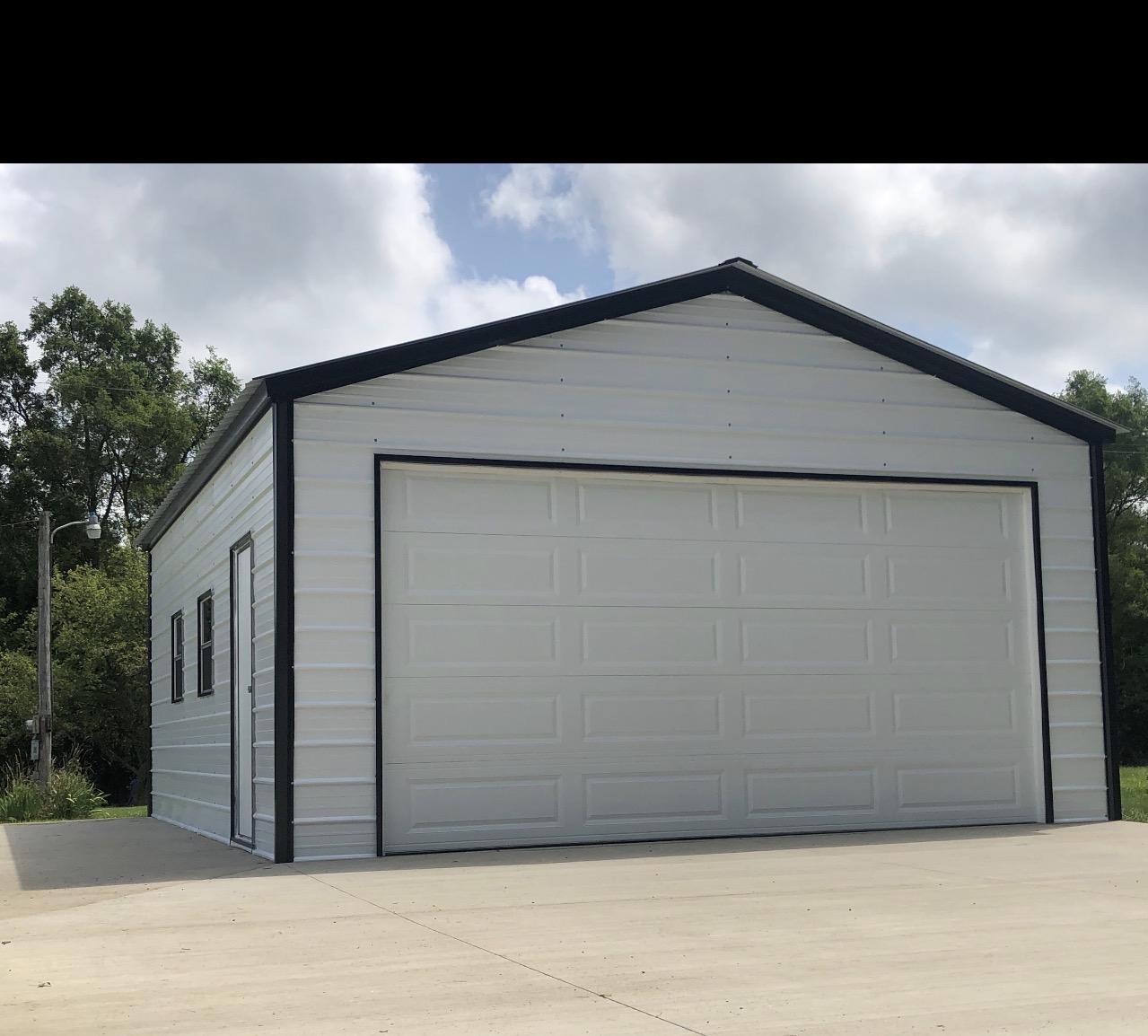
A metal building rusts when its protective coating is breached and moisture stays on the exposed steel. Rust prevention therefore comes down to four things: the coating on the panels, a design that sheds water, a foundation and site that keep moisture away, and a yearly look at the spots where coatings fail first. Get those right and a garage, carport or barn can go decades without a rust problem.
This guide is written for owners and buyers. It covers what to ask before you order, what to check once the building is up, and what to do when you find a patch of red.
TL;DR
- Coating quality matters most. For agricultural sheathing, G90 galvanizing is treated as the minimum for long-term protection, and aluminum-zinc (Galvalume-type) coatings also work as sacrificial layers.
- A coating is not a program. Design, drainage, fasteners, inspection and surface prep matter as much as the paint or zinc itself.
- Most rust starts at cut edges, scratches, fastener heads, ground contact and trapped water, so inspect those spots once a year.
- Condensation and wet ground do quiet damage. Ventilation, good grading and a proper pad prevent a lot of it.
- Small spots are cheap to fix early. Ask a specialist before you pick a coating for anything larger.
Table of Contents
- Why metal buildings rust in the first place
- Galvanized or Galvalume: what the coating label tells you
- Where rust really starts
- Farm buildings face a harsher environment
- The ground matters as much as the metal
- Our perspective: rust is a program, not a product
- A yearly inspection checklist
- What to do when you find rust
- Why prevention is worth the effort
- Building with rust protection in mind
- FAQ
- Sources
Why metal buildings rust in the first place
Steel is strong, cheap and easy to fabricate, which is why it is used in nearly every kind of construction. Corrosion is the price: left unprotected, carbon steel corrodes and has to be controlled to prolong its life. Rust needs three things: iron, oxygen and moisture. You cannot remove oxygen from a barn, so every strategy either keeps water off the steel or gives the water something else to attack first.
That is exactly how the three main coating types work, according to the same federal technical bulletin:
| Coating type | How it protects | Typical example |
|---|---|---|
| Barrier | Seals out moisture and oxygen | Epoxy, polyurethane paints |
| Inhibitive | Passivates the steel surface | Zinc phosphate primers |
| Sacrificial | Corrodes first so the steel does not | Galvanizing, zinc-rich primers |
Most metal building panels rely on the sacrificial type (zinc or aluminum-zinc) underneath, topped by a baked-on paint finish that acts as a barrier. The two layers back each other up. The paint keeps water off the zinc, and the zinc protects the steel where the paint is scratched.
Galvanized or Galvalume: what the coating label tells you
The coating designation on a panel is the single most useful number you can ask about. On agricultural sheathing in the US, G90 is considered the minimum acceptable standard. G90 means 0.90 ounces of zinc per square foot in total, which works out to roughly 0.76 mils per side. Coatings labeled AZ, such as Galvalume, use aluminum and zinc and also serve as an effective sacrificial layer.
What that means when you shop:
- Ask for the designation in writing. “Galvanized” alone does not tell you the zinc weight. G90 or an AZ rating does.
- Ask about the paint system on top. The finish is your first barrier and also the part you see fade or chalk.
- Ask who made the panels. Coil quality varies between mills and roll formers.
More coating is not automatically the answer for every building. Coating choice depends on the service environment, and heavy-duty systems like zinc-epoxy-urethane are the gold standard for coastal, high-humidity or chemical exposure but are overkill for dry, controlled storage. Match the spec to where the building will stand, and do not pay for protection you will not use.
Where rust really starts
In our experience, a failing panel face is rare. Rust usually begins at a handful of predictable spots.
Cut edges and scratches
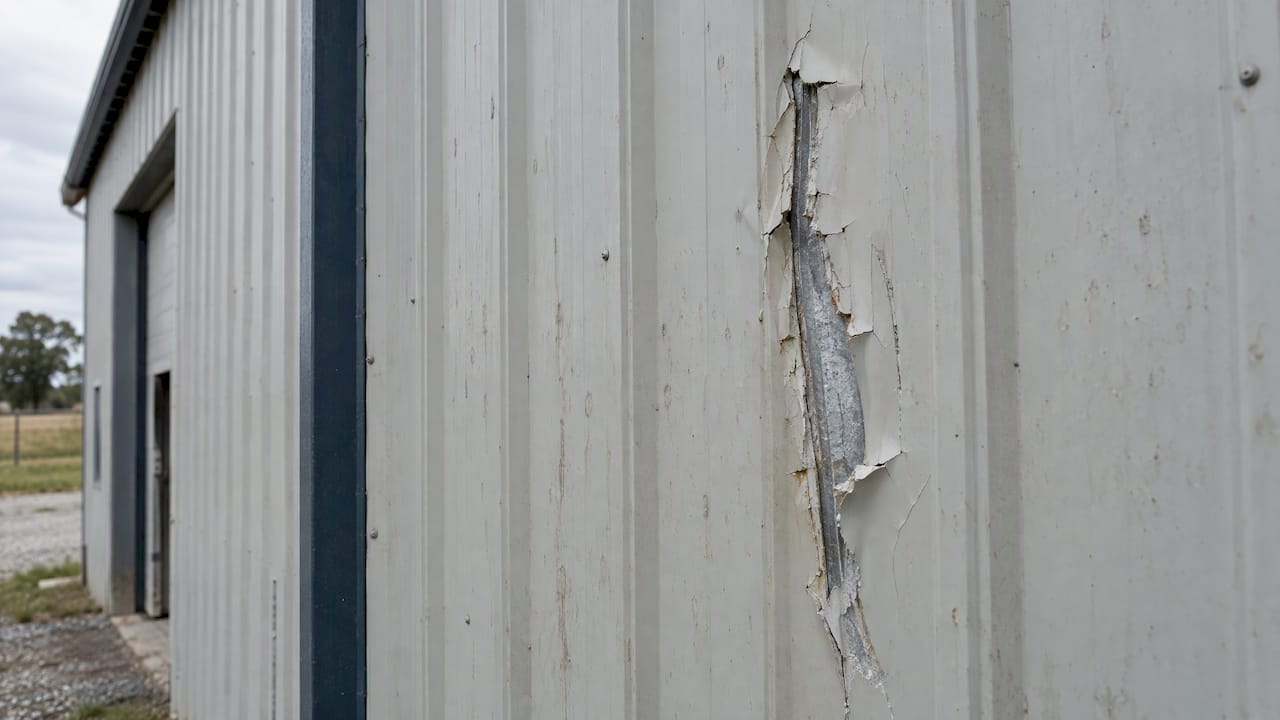
Every cut exposes bare steel. The zinc nearby protects it for a while through sacrificial action, but a large gouge from a ladder, a skid steer bucket or a dragged piece of lumber can outrun that protection. Flaking or peeling paint is the visible warning: once the finish is compromised, the metal underneath is exposed.
Fasteners and dissimilar metals
Screw heads, washers, anchor bolts and trim are small, but they are where water finds its way in. Two details matter:
- Where different metals touch outdoors, they should be separated. One university construction standard requires an approved bituminous coating, neoprene pads or similar between dissimilar metals, and calls for cutting anchor bolts flush to the nut and coating them with a rust-resistant product.
- Contact between dissimilar metals creates galvanic corrosion, so a mismatched fastener can eat at the panel it holds.
Water traps and slow drainage
AMPP points out that structural design is the most overlooked phase of rust prevention: water traps, sharp edges and inaccessible crevices let debris and moisture accumulate, and even the best coating fails there. On a real building this means:
- Roof pitch that sheds water instead of ponding it
- Gutters and downspouts that carry water away from the walls, not down them
- Trim and flashing that do not hold leaves, pine needles or silage dust against the metal
- A bottom edge of the wall that does not sit in a puddle
Condensation inside the building
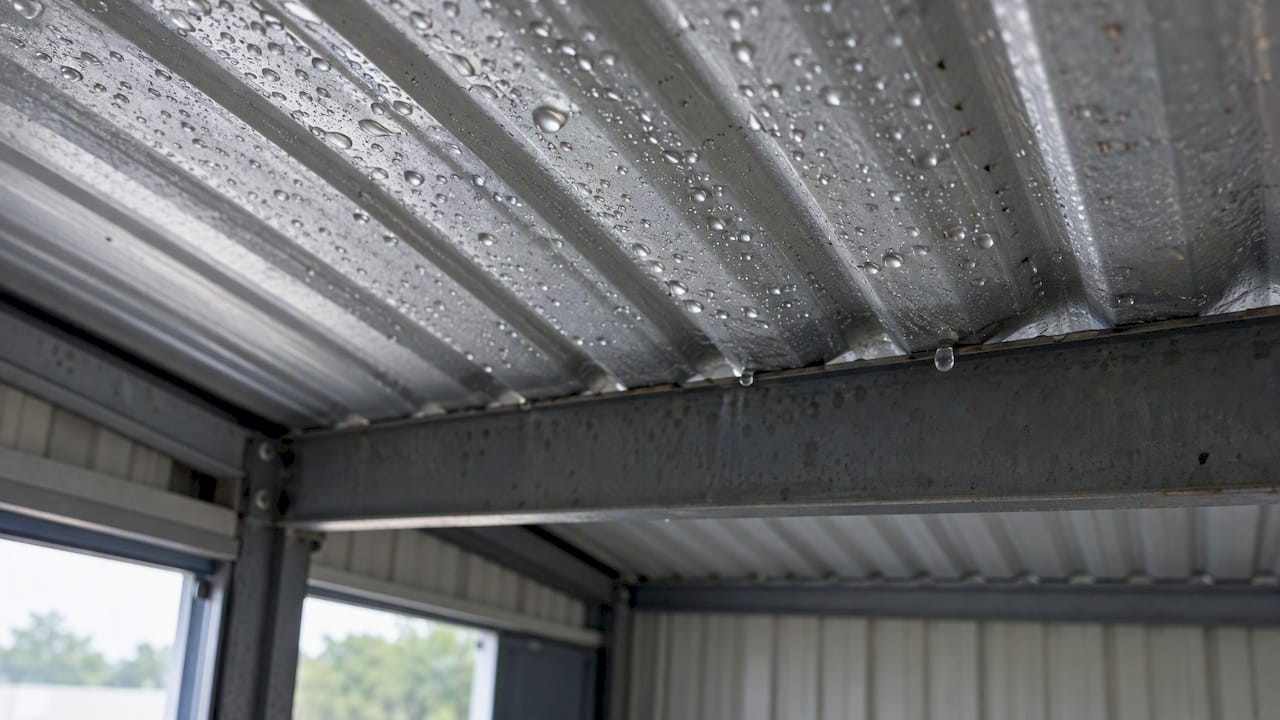
Rust is not only an outside problem. When warm, humid air meets a cool metal roof, water forms on the underside and drips onto whatever is below, including the steel frame. We cover the mechanics in our dew point checklist for metal building owners. The short version: ventilation, insulation or a condensation barrier, and keeping wet equipment out of a sealed, unventilated space.
White rust on new material
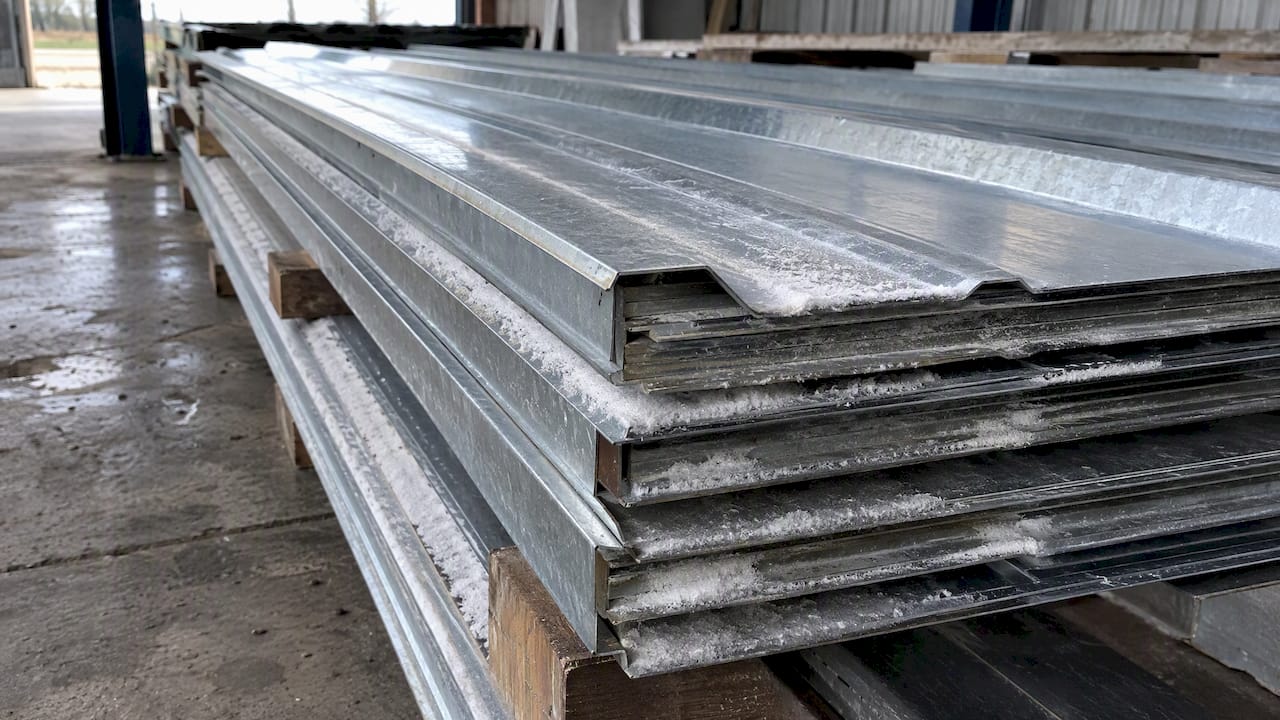
If you see a chalky white powder on new galvanized panels, that is white rust. It is a storage and handling issue rather than a manufacturing defect: it forms when fresh galvanized steel is packed tightly or stacked in humid, poorly ventilated conditions and moisture condenses between surfaces. The remedy is airflow between panels in storage and getting material installed promptly instead of letting bundles sit on site. It is one more reason a short gap between delivery and installation is good for you.
Farm buildings face a harsher environment
A barn is not a garage. Research on farm environments notes that ammonia, sulfates and chlorides from manure and silage speed up oxidation of both steel members and concrete reinforcement. If you are housing livestock, storing feed or fertilizer, or washing equipment inside, treat corrosion as a design requirement from day one.
Practical steps for ag buildings:
- Choose the heavier coating option when livestock effluent or fertilizer will be inside, and confirm the exact designation.
- Keep ventilation generous so ammonia and moisture do not hang in the air.
- Rinse residue off lower wall panels and trim rather than letting it dry in place.
- Keep stored manure, wet hay and fertilizer away from walls and columns.
- Check column bases and the lower few feet of wall panels more often than the rest.
If you are planning a barn, our page on metal barns and agricultural buildings shows the types we build, and our hay storage barn design guide covers layout concerns that overlap with moisture control.
The ground matters as much as the metal
The cheapest rust prevention happens before a single panel goes up. A building that sits on poorly graded soil collects splash-back, standing water and humidity at its base, which is where steel wall panels and column feet are most vulnerable.
What a good site does:
- Grades away from the building so water leaves the footprint.
- Uses a proper concrete pad or foundation with the base of the metal held clear of wet soil.
- Includes aprons and approaches so vehicle traffic does not turn the entrance into a mud and puddle zone.
- Leaves room for gutters to discharge away from the slab edge.
This is one of the practical reasons we do site prep, concrete and installation ourselves. When grading, slab and erection are handled by one crew with one point of contact, nobody can point at someone else when water ends up pooling against a wall. Details are on our Concrete & Foundations page.
Our perspective: rust is a program, not a product
Owners often ask us which paint or coating will make a building “rustproof.” We understand the question, but we think it is the wrong one. AMPP’s guidance says it well: corrosion prevention is a comprehensive program, and relying only on coatings is a mistake. It combines material selection, design that avoids water traps, routine inspection and professional-grade surface preparation.
Here is how we apply that to the buildings we sell:
- We only work with manufacturers whose products we trust. Coating quality is set at the mill and the roll former, and we would rather say no to a job than put our name on material we would not want on our own property.
- We keep the whole job under one roof. Site prep, concrete and installation done in-house means the drainage, the pad and the panels are planned together.
- We give straight answers before any deposit. If your intended use, such as a hog barn or a fertilizer store, calls for a different spec, you hear it in the quote, not after the building is up.
- We match the building to the use. A dry workshop and a livestock barn do not need the same protection, and we will tell you which one you are building.
No building is maintenance-free, and anyone who says otherwise is selling something. What you can expect is a building that has been set up to last, plus a short list of yearly chores that keep it that way.
— Stoots
A yearly inspection checklist
Set a reminder each spring, and look again after a major storm. Twenty minutes with a ladder, a flashlight and a notepad is usually enough.
| Where to look | What you are looking for | What to do |
|---|---|---|
| Lower wall panels | Splash marks, rust bloom, vegetation touching metal | Clear vegetation, clean, regrade if water ponds |
| Cut edges and trim | Orange or brown staining | Clean and treat early |
| Fastener heads | Rust streaks below screws, loose or backed-out screws | Tighten or replace with the correct fastener |
| Roof and valleys | Debris, ponding, peeling finish | Clear debris, flag finish damage |
| Gutters and downspouts | Overflow, clogs, discharge near the slab | Clean and extend discharge |
| Interior roof underside | Drip marks, damp insulation | Improve ventilation, see our condensation guide |
| Column bases and anchor bolts | Rust, moisture at the slab | Clean, coat, fix the water source |
| Doors and tracks | Rust at hinges and rollers | Clean and lubricate |
Our building care guide goes through routine upkeep in more detail, and our garage lifespan checklist shows how upkeep ties into how long a building lasts.
What to do when you find rust
First, identify what you are looking at. Surface staining from a rusty tool or a leaf pile is different from a fastener that has been weeping for years or a panel whose paint has failed across a large area.
For small, isolated spots, the usual approach is to remove loose rust and flaking paint, clean the area, then apply a compatible coating, ideally a zinc-rich primer followed by a matching topcoat. Zinc-rich primers are sacrificial coatings that corrode in place of the steel beneath, so they suit repair work on bare steel.
For anything bigger, slow down. The Bureau of Reclamation cautions that no coating system works in every environment, that the best choice depends on specific exposure conditions, and that universal do-it-yourself products are not the answer. Ask a specialist to match a system to your building’s conditions.
Three habits make repairs last:
- Fix the water problem first. Repainting a wall that is still splashed every rain only buys a season.
- Surface prep is the job. Coatings over loose rust or dirt fail early.
- Match the existing system. Mixing unrelated coatings can cause peeling.
If you are not sure whether damage is cosmetic or structural, call us or a qualified contractor before you buy materials.
Why prevention is worth the effort
The economics are on your side. An AMPP study found that half of all corrosion-related costs are preventable, and about 85% of those savings come from effective protective coatings. That figure covers industry broadly, not just backyard buildings, but the logic holds for an owner: the money is saved by choosing the right coating and keeping it intact, not by repairing after the fact.
If you are still deciding between building materials, our comparison of a metal garage versus a wood garage explains how the two age.
Building with rust protection in mind
If you are planning a new building, you can build many of these protections in from the start. We design, manufacture and install metal garages, carports, workshops, barns and barndominium shells, and we handle the grading and concrete too. Tell us how you will use the building, where it will stand and what it will store, and we will put the coating, drainage and foundation details in a transparent quote before you put down any deposit.
Start with our metal buildings lineup, browse real customer installs, or ask about a custom layout.
FAQ
How do I rust proof a metal shed or garage?
Start with panels coated to a recognized standard, such as G90 galvanizing or an aluminum-zinc coating, and a durable paint finish. Then control water: slope the ground away, add gutters, ventilate the interior and keep vegetation off the walls. Inspect yearly and treat scratches and fastener rust early.
What is the best rust-proof coating for steel?
There is no single best one. Zinc-epoxy-urethane systems are the top tier for coastal, humid or chemical exposure, while simpler urethane or acrylic systems often suffice for low-exposure structures. Pick based on where the building stands and what it holds, and consult a specialist for large areas.
Does a galvanized metal building ever rust?
Yes, if the coating is damaged and moisture stays on the exposed steel. Zinc protects cut edges and small scratches for a time, but deep gouges, failed paint, trapped water and harsh environments such as manure or fertilizer can overcome it. White rust on new panels comes from damp storage and is a handling issue.
Can I use a rust converter or a universal rust paint on my building?
For a tiny spot, a compatible touch-up is reasonable. For anything larger, the Bureau of Reclamation advises against universal products and recommends matching the system to the exposure conditions, ideally with a specialist’s input.
Sources
- Corrosion Protection of Steel, Technical Bulletin (NIH Office of Research Facilities)
- Choosing Metal Sheathing, Poultry Engineering, Economics & Management Newsletter (Auburn University)
- Coatings: the first line of defense in protecting structural steel (AMPP)
- How to Protect Metals (AMPP)
- Facilities Instructions, Standards and Techniques, Volume 4-5 (Bureau of Reclamation)
- Durability Issues and Corrosion of Structural Materials and Systems in Farm Environment
- Division 05, Metals (University of Alabama design guidelines)