A metal garage typically lasts somewhere between 25 and 60 or more years, and where you land in that range comes down to three things: coating type, climate exposure, and how well it was installed and maintained. Before you buy or inspect one, check the coating condition, drainage around the base, and fastener integrity. Those three spots tell you more than the building’s age ever will.
TL;DR:
- The lifespan of a metal garage depends primarily on coating quality, environmental exposure, and installation maintenance, with premium builds often exceeding 50 years.
- Galvalume (55% Al-Zn) coatings typically outperform galvanized steel in aggressive environments, offering twice the durability in long-term field tests.
- Coastal and industrial sites accelerate corrosion, especially if drainage, fasteners, or sealing details are neglected during installation.
- Regular maintenance such as cleaning, inspection, and prompt touch-up can significantly extend a garage’s service life beyond initial expectations.
- A detailed quote should specify coating type, fastener material, drainage, and sealing features, as these have a larger impact on longevity than paint color or visible finish.
Table of Contents
- Typical Lifespan Ranges by Build and Finish Level
- How Coatings Like Galvanized and Galvalume Change Lifespan
- Environmental and Installation Factors That Shorten a Garage’s Life
- Maintenance That Extends a Metal Garage’s Life
- Signs That Mean Repair Is Enough, and Signs That Mean Replace
- Turning Coating Life Into a Maintenance Budget
- What a Quote Should Guarantee Before You Sign
- What Homeowners Get Wrong About Metal Garage Lifespan
- Get a Site-Specific Quote for Your Metal Garage
- FAQ
- Sources
Typical Lifespan Ranges by Build and Finish Level
Not all metal garages age the same way, even when they look identical on delivery day. The finish level and build quality set the ceiling on how long the structure will perform before major repairs become necessary.
- Entry-level builds: thin-gauge steel with basic painted finishes tend to show surface rust and seam failures within 15 to 25 years, especially with poor drainage or minimal fastener maintenance.
- Standard prefab construction: galvanized panels with routine upkeep commonly reach several decades before coatings need significant touch-up or replacement.
- Premium or spec-built structures: thicker gauge steel paired with high-performance coatings and detailed flashing can push service life past 50 years, sometimes well beyond 60.
You can often verify which category a garage falls into just by looking. Chalky, fading paint with rust bleeding at seams points to entry-level materials aging fast. Clean panel seams, intact ridge caps, and no rust streaking at fasteners suggest a standard or premium build holding up as designed. The gap between these tiers is rarely about age alone. It is about what was specified before the first panel ever went up.
How Coatings Like Galvanized and Galvalume Change Lifespan
The metal coating underneath the paint matters more than most homeowners realize, because it determines how the steel behaves once moisture finds a scratch or cut edge.
Hot-dip galvanizing coats steel in zinc, which protects sacrificially: the zinc corrodes first and slower than bare steel would, buying years before the base metal is exposed. This is why a galvanized garage doesn’t rust the moment a screw scuffs the surface. The American Galvanizers Association’s Zinc Coating Life Predictor estimates time to first maintenance for hot-dip galvanized steel based on local environment and coating thickness, a tool professionals use to set realistic maintenance schedules rather than guess.
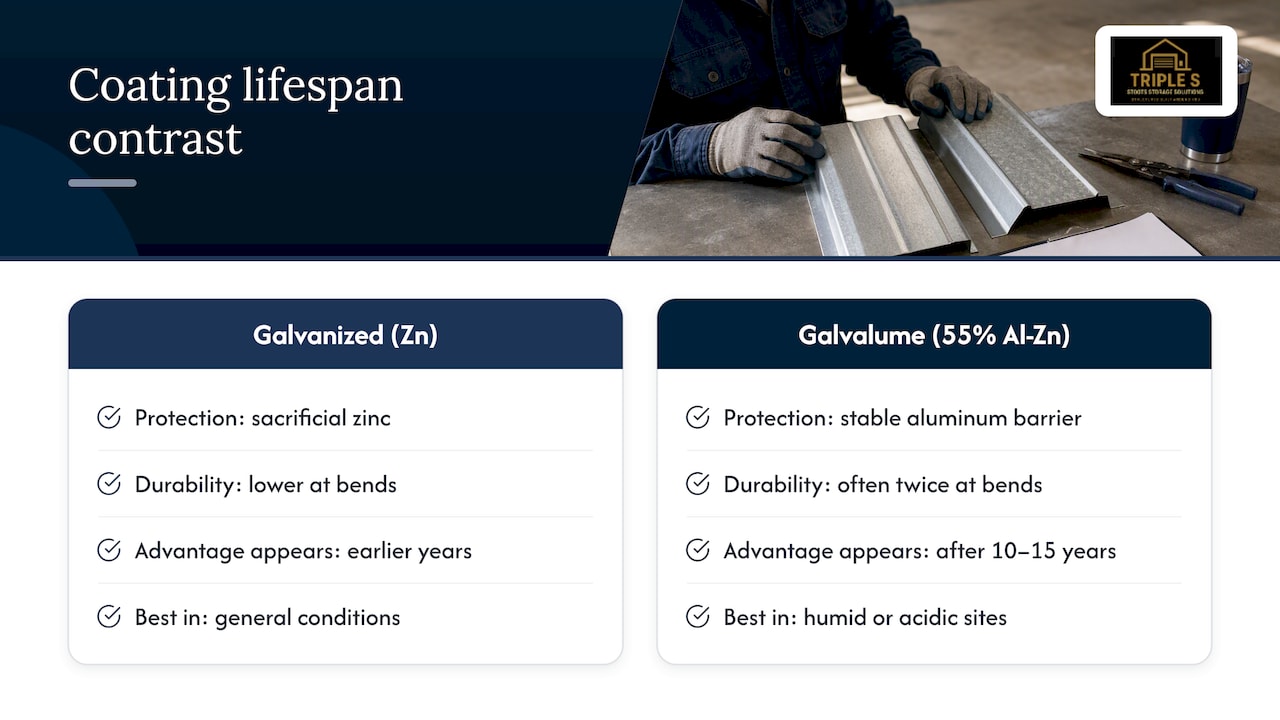
Field surveys and long-term tests show that prepainted 55% Al-Zn substrates often outperform hot-dip galvanized substrates over extended exposure, with a durability advantage that becomes clear after roughly 10 to 15 years in aggressive environments.
55% Al-Zn coating, often sold as Galvalume, frequently shows twice the durability of galvanized steel at panel bends in long-term field surveys, according to a coated-steel performance briefing. The aluminum content forms a more stable barrier in humid or acidic conditions, which is why many premium garage panels now specify it over plain zinc.
Paint sits on top of all this and matters for appearance and added UV resistance, but it is not the primary defense. A quality metallic substrate under a mediocre paint job will usually outlast a great paint job over galvanized steel that was too thin to begin with. When you’re comparing quotes, ask what’s under the paint before asking what color it comes in.
Environmental and Installation Factors That Shorten a Garage’s Life
Climate and site conditions can cut years off a metal garage’s expected service life, often faster than the coating itself wears out.
Coastal salt spray, winter deicing salts, and industrial pollutants accelerate corrosion at a pace that inland, low-humidity sites never see. High ambient humidity alone, without any salt, still speeds up coating breakdown at seams and fasteners. These are documented as the main drivers of why corrosion-protection performance varies so much by exposure class in the Steel Bridge Design Handbook’s corrosion protection module, which applies the same underlying principles that govern residential steel structures.
Installation details matter just as much as climate:
- Drainage and standing water: base rails sitting in water or buried in soil trap moisture against the steel and accelerate rust from the inside out.
- Concrete interface: an improperly sealed slab-to-wall junction wicks moisture upward into the panel base.
- Fastener compatibility: mismatched metals between fasteners and panels trigger galvanic corrosion at every screw point.
- Cut-edge protection: unsealed field cuts expose bare steel that bypasses whatever coating protection the panel originally had.
Pro Tip: Ask any installer to specify fastener material, cut-edge treatment, and base rail drainage in writing before you sign, not after the slab is poured.
A quote that skips these details isn’t necessarily a bad one, but it’s an incomplete one. Site prep and installation quality often determine whether a 40-year coating performs for 40 years or for 20.
Maintenance That Extends a Metal Garage’s Life
A consistent, modest maintenance routine does more for lifespan than any single coating upgrade. Most of it takes less than an hour a few times a year.
- Spring and fall inspection: walk the perimeter checking for rust streaks at seams, loose fasteners, and standing water near the base rail.
- Monthly quick check: glance at gutters and downspouts for debris that redirects water against wall panels.
- Rinse off salt and pollutants: hose down panels two to four times a year in coastal or high-traffic road-salt areas, more often after storms.
- Spot-prime exposed steel: touch up any scratch or chip down to bare metal as soon as you spot it, before surface rust spreads.
- Call a professional for large rust patches or panel replacement: anything beyond a small scratch is worth a second opinion before it becomes a structural issue.
- Service moving parts and seals: lubricate door hardware and check weatherstripping annually, since failed seals let in the moisture that ages everything else faster.
None of this requires special tools or expertise, just a calendar reminder and a willingness to act on small problems before they compound.
Signs That Mean Repair Is Enough, and Signs That Mean Replace
Surface rust that wipes off or sands away is almost always repairable with a primer and matching paint. Rust that has created pitting or visible thickness loss, where you can see or feel a difference in the metal, points toward panel replacement rather than a patch job.
- Structural deformation: sagging rooflines, bowed wall panels, or loose connections at the frame signal a problem beyond surface treatment.
- Recurring water intrusion: leaks that return after sealing usually mean the water path is structural, not cosmetic.
- Rot at embedded components: wood framing or door jambs touching damp concrete or soil often fail before the steel does.
- Insulation failure: damp or sagging insulation inside the walls suggests moisture has been getting in for a while.
Repairs are generally far less costly than replacement, which is why catching these signs early matters more than the inspection itself.
Turning Coating Life Into a Maintenance Budget
Time-to-first-maintenance is simply the point when a coating needs its first real touch-up, not full replacement. It’s a planning number, not a failure date, and it moves depending on coating thickness and how aggressive your local environment is.
A thicker zinc coating in a dry, rural setting might not need attention for 20 or more years, while the same coating in a coastal or industrial zone could need touch-up closer to the 10-year mark. Thinner coatings move those numbers down proportionally in both cases.
Here’s how to translate that into a 10 to 30 year budget:
- Schedule your first detailed coating inspection around year 10 regardless of how the structure looks.
- Budget for spot touch-up work every 10 to 15 years in moderate climates.
- Plan for a possible panel refinish or replacement cycle around year 25 to 30 in higher-exposure environments.
What a Quote Should Guarantee Before You Sign
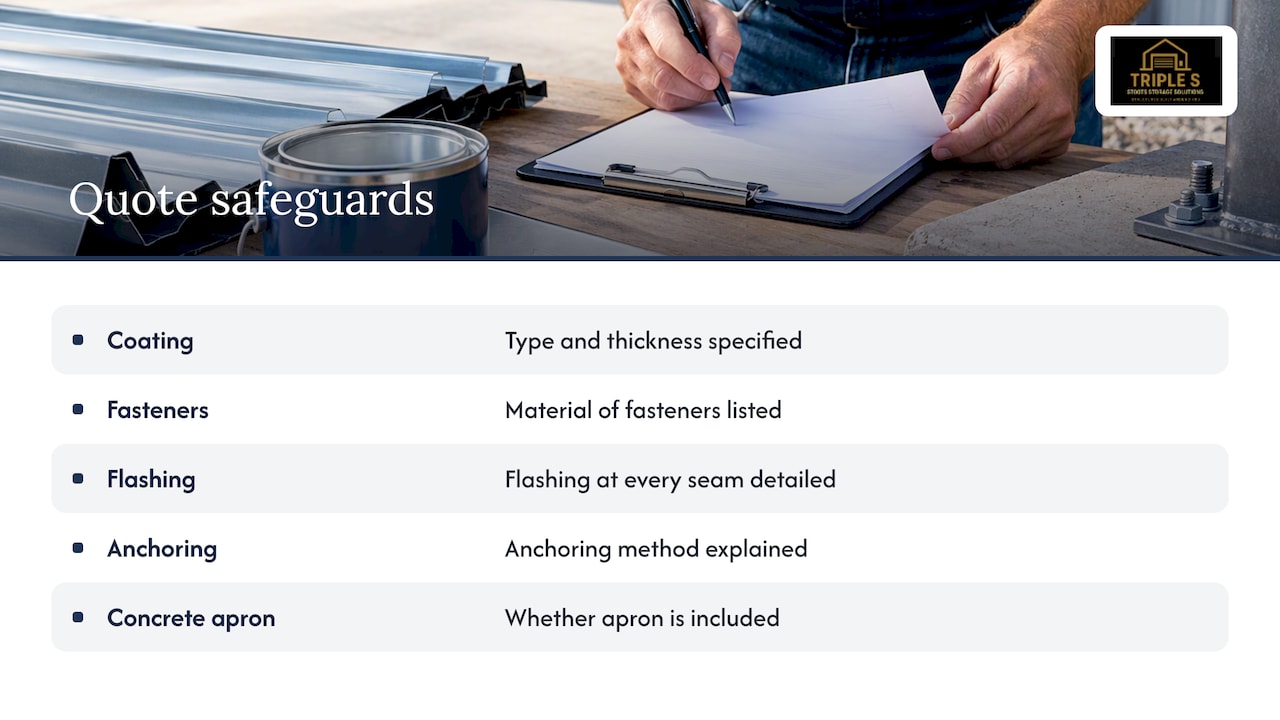
A solid quote spells out more than price. It should specify coating type and thickness, fastener material, flashing details at every seam, anchoring method, and whether a concrete apron is included. These line items are what separate a garage that needs attention at year 15 from one that doesn’t.
We build with single-source responsibility, handling site prep, concrete, and installation under one team rather than splitting it across subcontractors. That reduces the gaps where moisture problems and coating failures tend to start, since the same crew responsible for the foundation is also responsible for how the structure sits on it.
What Homeowners Get Wrong About Metal Garage Lifespan
Most lifespan advice online treats coating type as the whole story, and it isn’t. A premium 55% Al-Zn panel installed over a poorly drained slab will corrode at its base years before the coating itself would have failed on a dry, well-graded site. Installation quality and site conditions deserve at least as much attention as the spec sheet, and buyers rarely ask about either.
The other overrated factor is paint color and cosmetic finish. Paint matters for curb appeal and some UV protection, but it’s the metallic substrate underneath that does the structural work. Spending more on a premium topcoat over a thin galvanized panel is often money misallocated.
If you take one thing from this, prioritize the fastener specs, cut-edge treatment, and drainage details in your quote before you compare paint swatches. Those unglamorous line items are what determine whether you’re maintaining a garage at year 15 or replacing one.
— Stoots
Get a Site-Specific Quote for Your Metal Garage
A lifespan range only tells you so much. What actually determines how long your garage lasts is your soil, your climate, and how the slab and panels come together on your specific lot, which is exactly what a site visit is for.
We offer:
- Custom garages, workshops, and barn-style buildings built to your site and climate, not a generic catalog spec.
- Concrete and foundation work done in-house, so drainage and anchoring are handled by the same team building the structure above it.
- Turnkey installs that cover grading, aprons, and approaches in one contract instead of several separate vendors.
If weatherproofing around doors and seals is a concern alongside corrosion, a quick read on practical garage door security fixes covers seal and hardware issues that double as moisture entry points.
We give straight answers and a transparent quote before any deposit changes hands. Request an on-site or virtual consultation and walk through the checklist, coating, fasteners, drainage, and anchoring, with someone who will actually be building it.
FAQ
What is the average lifespan of a steel garage door?
Steel garage doors generally last 15 to 30 years depending on coating quality, coastal or road-salt exposure, and how often moving hardware gets serviced. Panels with galvanized or Galvalume-type coatings tend to outlast plain painted steel, especially in humid or salty climates.
How long will a garage last?
A metal garage typically lasts 25 to 60 or more years depending on coating type, local climate exposure, and maintenance quality. Wood-framed garages generally fall on the shorter end of that range because wood framing is more vulnerable to rot and pest damage than coated steel.
How long does a garage cable last?
Garage door torsion and extension cables typically need periodic replacement under normal use, though salty or humid air can shorten that window. Fraying strands, visible rust, or a door that feels unbalanced are signs a cable needs attention sooner.
Can a garage be made longer?
Many prefab metal garage designs can be extended in length during the planning stage since wall panels and roof trusses are modular by design. Extending an existing structure after installation is possible in some cases but depends on the foundation layout and framing, so it’s worth discussing with whoever handles your site prep and installation.
Leave a Reply