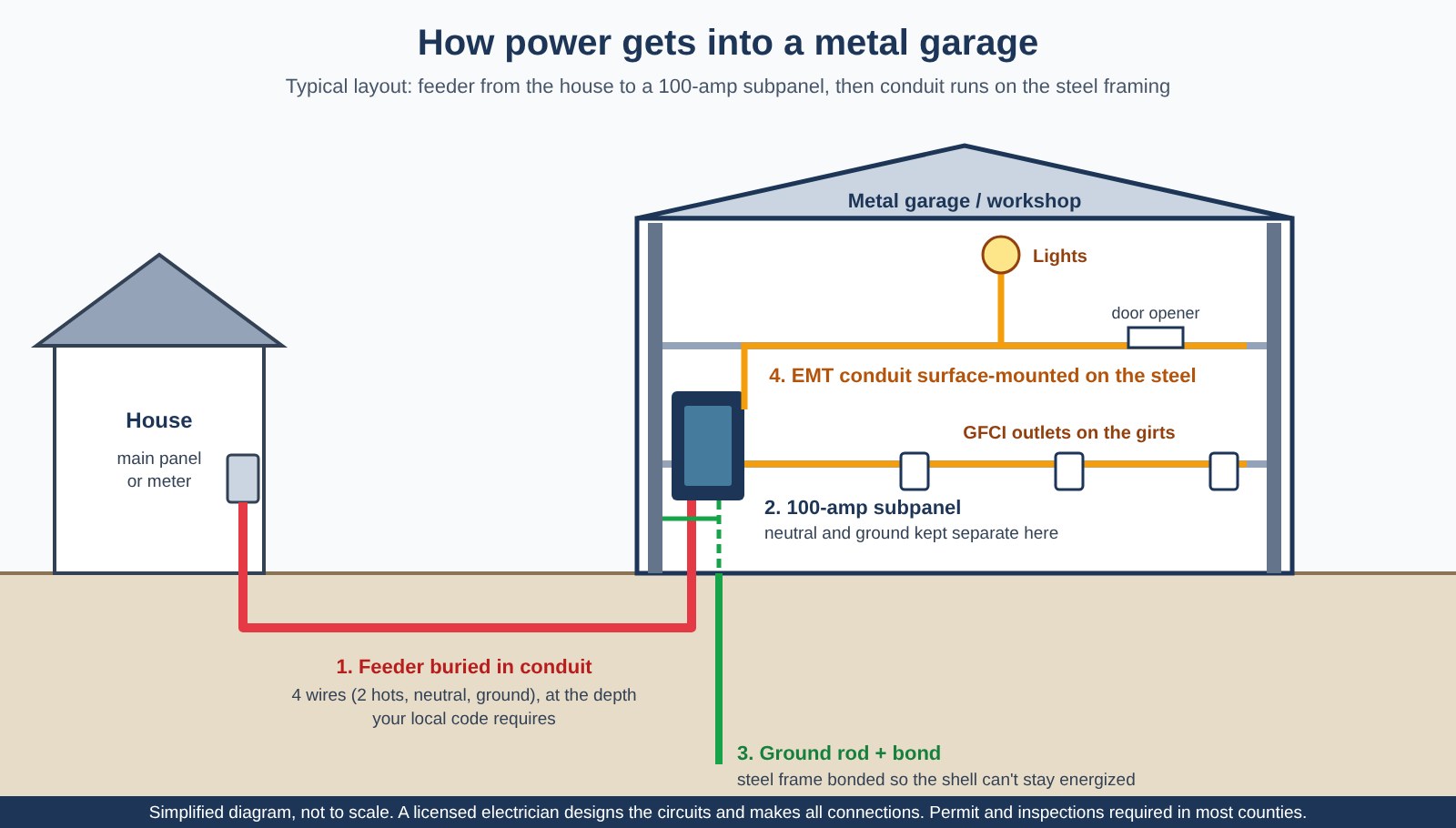
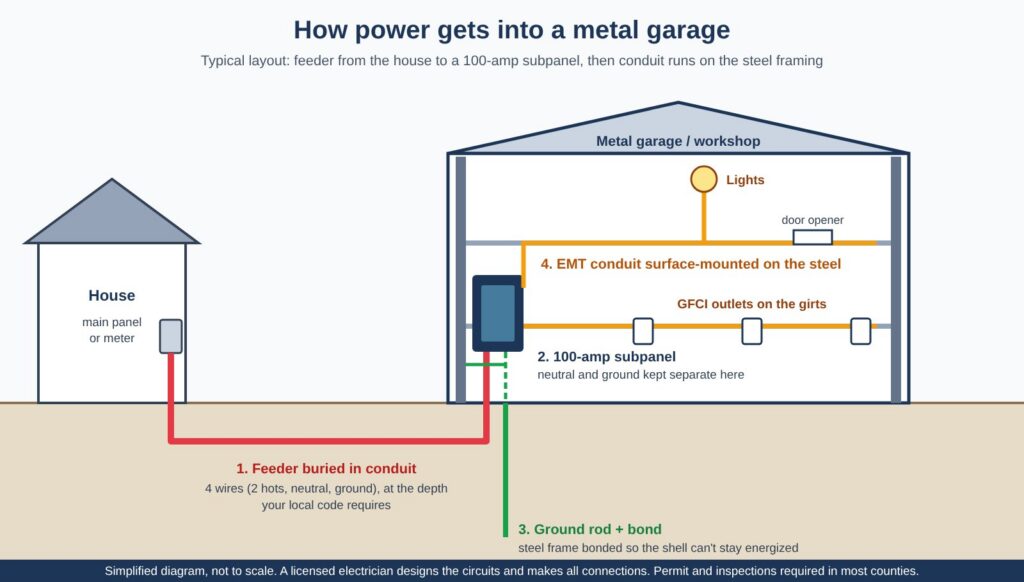
Most homeowners spend about $1,000 to $3,800 to run power to a detached garage, and more once you add a subpanel and wiring inside. The biggest factor is distance: national cost guides put an underground run at about $10 to $25 per foot. Add roughly $500 to $1,500 for a 100-amp subpanel, $50 to $350 for the electrical permit, and possibly a main panel upgrade if your house is short on capacity. A licensed electrician should price your exact job, but these numbers will tell you if a quote is in the right range.
TL;DR:
- Distance drives the price: about $1,000 to $2,500 for a 100-foot underground run.
- A 100-amp subpanel adds about $500 to $1,500. Wiring inside the building is extra.
- Houses with 100-amp service may need a main panel upgrade first.
- Plan the trench route and conduit before the slab is poured to save money later.
Cost by distance
These are typical installed costs for an underground line from the house to the building, before the subpanel and interior wiring. They come from national cost guides (HomeGuide and Angi, 2024 data), so local prices in Southwest Virginia and North Carolina can land above or below them.
| Distance from the house | Typical underground cost |
|---|---|
| 50 ft | $500 to $1,250 |
| 100 ft | $1,000 to $2,500 |
| 150 ft | $1,500 to $3,800 |
| 200 ft | $2,000 to $5,000 |
| 300 ft | $3,000 to $7,500 |
Once you add a subpanel and wiring inside the building, HomeGuide puts the average total at about $1,200 to $7,100.
What drives the cost
- Distance. Longer runs need more wire and conduit, and longer runs need bigger wire to keep voltage drop down.
- Trenching. Professional trenching runs about $5 to $12 per foot. Rock, roots, and crossing a driveway or sidewalk add time.
- How much power you want. A couple of lights and outlets can run on a small circuit. A shop with a compressor, welder or heater usually needs a 100-amp subpanel and a heavier feeder.
- Your main panel. If the house panel is full or only 100 amps, it may need an upgrade before it can feed the garage.
- Permits and inspections. Electrical permits run about $50 to $350, and some counties charge for inspections separately.
- Interior wiring. Outlets, lights, and conduit runs on the steel framing are priced on top of the feeder.
Subpanel cost
HomeGuide lists about $500 to $1,500 to install a 100-amp subpanel, about $400 to $600 for a 50 to 60-amp panel, and about $800 to $2,000 for 200 amps. For most garages and workshops, 100 amps leaves room for lights, outlets, a heater and a few tools. Our metal building electrical guide covers why 100 amps is the usual pick, plus grounding and bonding the steel frame.
Will you need a main panel upgrade?
A lot of older houses have 100-amp service. Feeding a 100-amp garage subpanel from that can leave too little for the house, so an electrician may recommend upgrading the main panel to 200 amps. HomeGuide lists about $1,400 to $2,800 for that upgrade. Some owners put a separate meter at the building instead; that is a conversation for your power company and electrician. Ask for a load calculation before you decide.
Permits and inspections
In most Virginia and North Carolina counties, a new feeder and subpanel need an electrical permit, a rough-in inspection before anything is covered, and a final inspection. Rules and fees vary by county, so call your local permit office first. Our permit guides for Virginia and North Carolina explain who to call.
Planning power for a new garage or shop? Tell us where the panel and outlets will go before we build, and we will plan the slab and framing around it.
Ways to keep the cost down
- Site the building with power in mind. Every foot closer to the house saves wire and trench. Balance that against setbacks and drainage.
- Plan the trench route early. Keep it out from under driveways and future concrete, and run it before final grading if you can.
- Put a conduit sleeve in the slab. If we know where the feeder comes up, a sleeve can go in before the pour, so nobody has to cut concrete later.
- Size it once. If you might add a heater, welder or lift later, it usually costs less to pull a heavier feeder now than to redo the trench.
- Get two or three electrician quotes and make sure each one lists the wire size, conduit, trench depth, subpanel size and permit.
How we get a building ready for your electrician
We do not do the electrical work. A licensed electrician designs the circuits and makes the connections. What we do is build the garage, workshop or barn with the wiring in mind: planning conduit sleeves through the slab, leaving room around framing and openings for the panel and outlets, and coordinating our site prep with where the feeder will run. See our metal garages and metal workshops pages, or build and price yours.
FAQ
How much does it cost to run power 100 feet to a garage?
National cost guides put an underground run of about 100 feet at roughly $1,000 to $2,500, not counting the subpanel or wiring inside the building. Rocky ground, long trenches under driveways, or a main panel upgrade can push it higher.
Do I need a subpanel in a detached metal garage?
If you want more than a couple of circuits, usually yes. A subpanel lets you run separate circuits for lights, outlets, a heater and tools. Many shops use a 100-amp subpanel, and cost guides list about $500 to $1,500 to install one.
Will I have to upgrade my main electrical panel?
Maybe. If your house has 100-amp service, there may not be enough capacity left to feed a garage subpanel. A licensed electrician can run a load calculation and tell you. Cost guides list about $1,400 to $2,800 to upgrade a main panel from 100 to 200 amps.
Do I need a permit to run power to a detached garage?
In most Virginia and North Carolina counties, yes. A new feeder and subpanel usually need an electrical permit and inspections. Permits typically run about $50 to $350, depending on the county.
Leave a Reply