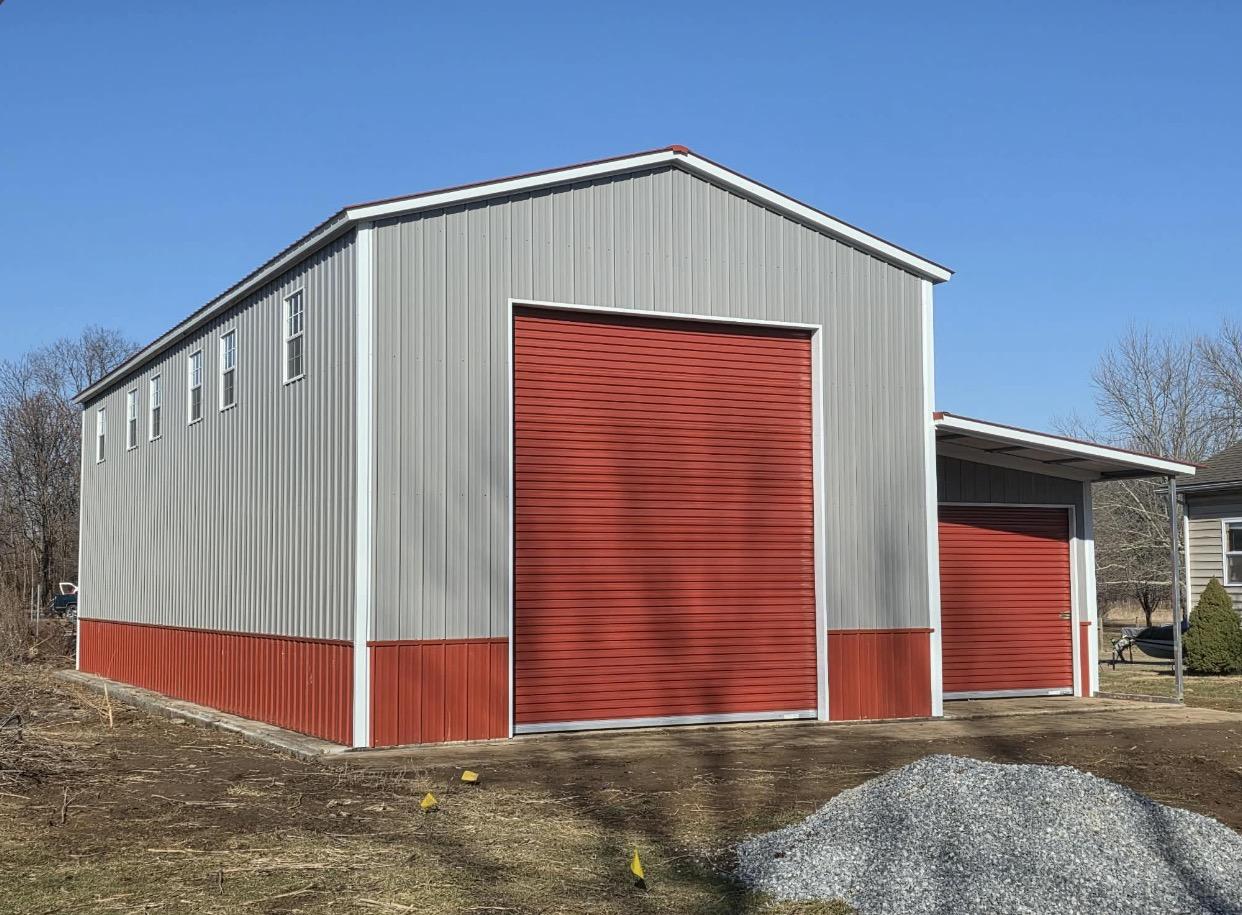
It depends on your county or town. West Virginia has a State Building Code, but it only has force where a county or city has adopted it, and plenty of rural areas have not. Buildings used mainly for farming are exempt from the State Building Code. What applies almost everywhere is floodplain management: every county and flood-prone town in the state takes part in the National Flood Insurance Program, and building in a flood zone usually needs a local floodplain permit. Call your county commission, and your town if you are inside city limits, before you order a metal building.
To find your county’s permit office, try our metal building permit finder by county.
TL;DR:
- The West Virginia State Building Code uses the 2018 International Building Code and 2018 International Residential Code.
- Counties and cities choose whether to adopt it. Where they have not, there may be no building permit at all.
- Where it is adopted, the local government enforces it and issues permits.
- Buildings used primarily for agricultural purposes are exempt from the State Building Code and local building codes.
- Floodplain permits are the big one in the valleys. Check the WV Flood Tool and call your county’s floodplain manager.
Southern West Virginia is right next door to our shop in Galax, Virginia, and we build garages, barns and shops there. Here is how permits work in West Virginia and what to check before you build.
Who decides
The West Virginia State Fire Commission writes the State Building Code as a state rule (87CSR4). It adopts the 2018 editions of the International Building Code and the International Residential Code, along with related codes for plumbing, mechanical and electrical work.
But state law makes adoption a local choice. Under W. Va. Code §15A-11-5, the code has force in counties and cities that adopt it, and enforcement “is the responsibility of the respective local jurisdiction.” A county or city that adopts it has to notify the State Fire Commission and send a copy of its ordinance to the State Fire Marshal. Questions about how the code is applied are left to the local jurisdiction.
In plain terms: your county or city building office decides, not the state. If your county never adopted the code, there may be no county building permit for a garage or barn. A town inside that county may still have its own.
Counties without building codes
Many West Virginia counties have not adopted a building code. A West Virginia University land use guide (WV LEAP) noted that as of June 2015, 61 communities had adopted the State Building Code: 9 counties and 52 cities and towns. Things may have changed since, but the point stands. In a lot of rural West Virginia, the permit you need is not a building permit.
That does not mean anything goes. Even without a building code, you may still need:
- A floodplain or location permit from the county
- Approval from your town if you are inside city limits
- Septic or electrical permits if you add a bathroom or power. Ask your county what applies.
And a building with no permit still has to stand up to the wind and snow. That is why we order every building certified for local loads.
The agricultural exemption
West Virginia law says buildings or structures used primarily for agricultural purposes are exempt from the State Building Code, the State Fire Code and local building codes. The state rule adds agritourism to that exemption.
“Agricultural purposes” is defined in W. Va. Code §15A-11-3. It covers raising, harvesting, marketing, producing or storing crops and livestock for sale or for use in farming, and storing machinery or equipment used in farm production. A hay barn, livestock shelter or equipment shed on a working farm usually fits.
If there is a question about whether your building qualifies, the state rule says it goes to the Commissioner of Agriculture to decide. You give the location, the kinds of farm use and how often each happens. Keep in mind that the farm exemption covers building codes. It does not get you out of floodplain rules.
Floodplain permits
This is the permit that catches people. According to the WV Department of Environmental Protection, every county and flood-prone municipality in West Virginia participates in the National Flood Insurance Program. Local floodplain ordinances define “development” to include filling, grading and excavation, not just buildings. So a garage pad graded in a flood zone can need a permit even in a county with no building code.
State law also gives county commissions the power to require permits and inspect construction in flood hazard areas to meet the National Flood Insurance Act.
Before you pick a spot, look up your parcel on the WV Flood Tool. It shows the flood zone, flood height and ground elevation for an address or tax parcel. Then call your county floodplain manager.
Southern West Virginia counties
Mercer County. Inside the City of Bluefield, the Code Enforcement Department issues building permits, and the city says they are required for all jobs except painting, wallpapering, trim work, floor sanding, carpeting and landscaping. Call 304-327-2401 x2462. Inside the City of Princeton, the city says a permit is required before you build, and its building permit application lists garages and carports. Call Princeton at 304-487-5020. Outside city limits, call the Mercer County Commission. See our Mercer County page.
Monroe County. The county’s Improvement Location Permit Ordinance says no building or structure can go up until you get a permit from the county permit office. It is about location and flood damage, not building code inspections. The fee for residential or agricultural property is $5 outside the floodplain and $50 inside it, where compliance has to be monitored. See our Monroe County page.
McDowell, Summers and Wyoming counties. We could not find a published building permit program on these county websites. Call the county commission to ask what applies to your lot, especially near a creek: McDowell County in Welch at (304) 436-8548, Summers County in Hinton at (304) 466-7100, and Wyoming County in Pineville at 304-732-8000. See our McDowell, Summers and Wyoming county pages.
What a permit office usually wants
- A site plan showing the building, property lines, the road, septic and any stream
- The building’s engineered drawings with its wind and snow load ratings
- Foundation details: slab or footers and footer depth. West Virginia frost lines can run deeper than much of the South.
- Square footage, building use and project cost
- Flood zone information if the lot is near a floodplain
Setbacks come from zoning where a town or county has it, and from deed restrictions or HOA rules where they exist.
Tips that save time
- Call the county commission and ask two questions: is there a building permit here, and is my parcel in a floodplain?
- If you are inside city limits, call the city, too.
- If the building is for farm use, ask how they handle the agricultural exemption.
- Check the WV Flood Tool before you grade anything.
- Tell us what the county said. We will match the foundation to it.
See every area we cover on our West Virginia service page, and our permit help page for a list of questions to bring. Building in Virginia instead? Read Do You Need a Permit for a Metal Building in Virginia?. Every county is different and rules change, so treat this as a starting point, not legal advice.
Building in southern West Virginia? Tell us your county and we will help you figure out what it needs before you order.
Call 276-235-1191 for a Free Quote
Ready to price your own? Build & Price Your Building
FAQ
Do I need a permit for a metal building in West Virginia?
It depends on where you build. The State Building Code only applies where a county or city has adopted it, so some rural areas have no building permit. Floodplain, septic and electrical rules can still apply, and many towns do require a permit.
Does the West Virginia State Building Code apply everywhere?
No. Counties and cities choose whether to adopt it. Where it is adopted, the local government enforces it and issues permits.
Are farm buildings exempt in West Virginia?
Yes. Buildings used primarily for agricultural purposes are exempt from the State Building Code, the State Fire Code and local building codes. If eligibility is in question, the Commissioner of Agriculture decides. Floodplain rules still apply.
Do I need a floodplain permit?
If your building or grading is in a mapped flood zone, usually yes. Every county and flood-prone municipality in West Virginia takes part in the National Flood Insurance Program, and local ordinances count filling and grading as development. Check the WV Flood Tool and call your county.
What permit does Monroe County require?
Monroe County requires an Improvement Location Permit before any building or structure goes up. It is a location and floodplain permit, not a building code inspection. The fee for residential or agricultural property is $5 outside the floodplain and $50 inside it.
Do I need a permit inside Bluefield or Princeton?
Yes. Bluefield requires building permits for all jobs except painting, wallpapering, trim work, floor sanding, carpeting and landscaping. Princeton requires a permit before you build, and its application covers garages and carports.
Can you help with the permit?
Yes. Every building we sell is certified for local wind and snow loads, and engineered drawings are available, which is usually what a permit office asks for. Tell us what your county needs and we will match the foundation to it.
Sources
- W. Va. Code §15A-11-5: State Building Code
- W. Va. Code §15A-11-3: definition of agricultural purposes
- W. Va. 87CSR4 §87-4-4: national codes adopted, §87-4-7: adoption by local jurisdiction, §87-4-9: agricultural exemption
- West Virginia University, WV LEAP: Building Code
- WV DEP: Floodplain permits
- W. Va. Code §7-1-3v: county flood hazard powers
- WV Flood Tool
- City of Bluefield: Code Enforcement
- City of Princeton: Notice to Contractors and Application for Building Permit
- Monroe County Commission: Improvement Location Permit Ordinance
Leave a Reply