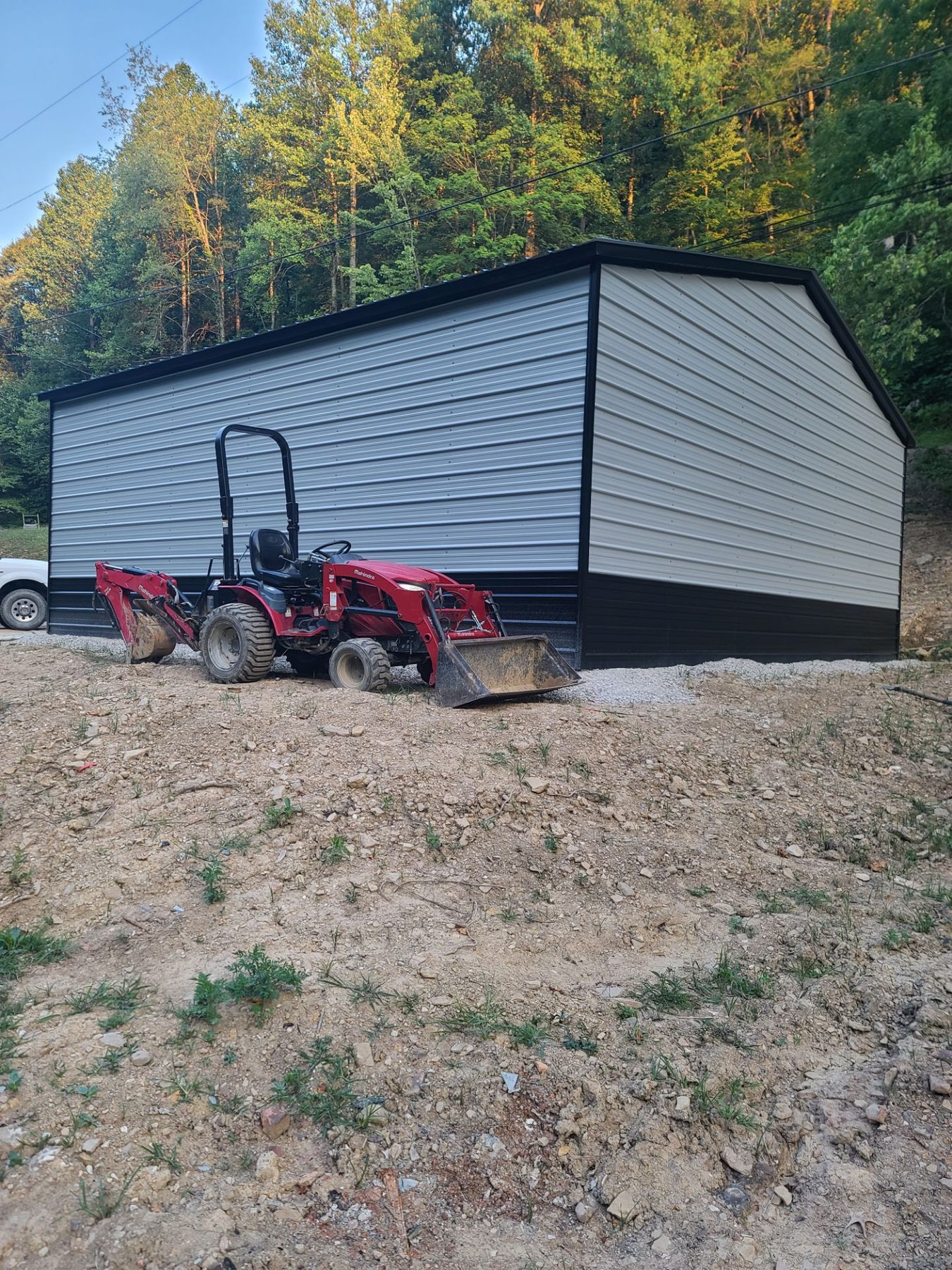
Size a tractor shed around everything that has to fit, not the tractor alone: add up the length × width of the tractor and every implement you keep, then add 15% for space between them. Make the door at least 2 feet wider and 1 foot taller than your biggest machine as it will actually be parked.
Most tractor sheds that let their owners down aren’t too expensive. They’re too small. A loader, a bush hog and a trailer take up far more room than the tractor’s spec sheet suggests, and the door and wall height matter as much as the floor plan. Here’s how to measure, do the math and pick a size you won’t outgrow.
Storing a UTV alongside the tractor, or instead of one? Our UTV garage size guide covers side-by-side dimensions and the door height that clears a roof rack.
Step 1: Measure what has to fit
Grab a tape measure and list every machine and implement that will live under the roof. Measure each one the way it will really be parked:
- Length: from the front of the loader bucket or front weights to the back of anything that stays hitched.
- Width: at the widest point, usually the rear tires, the bucket or a mower deck.
- Height: at the tallest point, including the roll bar, exhaust, cab or a raised loader.
Whether an implement stays hitched changes everything. Virginia Tech’s guide to farm storage buildings points out that the floor space each item needs depends on how it folds and whether implements stay attached. A mower left on the three-point hitch adds its full length to the tractor’s.
A cheap way to check your numbers: stake out the footprint you’re thinking about with string, then park everything inside it. It’s much easier to find out it’s too small with stakes than with a finished building.
Step 2: Typical floor space for tractors and implements
If you don’t have every measurement yet, Purdue Extension’s Planning Guide to Farm Machinery Storage lists typical sizes. Your own machines will vary, so use these as a starting point and measure when you can.
| Equipment (Purdue AE-115) | Length × width | Floor area |
|---|---|---|
| 2WD tractor, 2–3 plow | 11.5 × 8 ft | 92 sq ft |
| 2WD tractor, 4–5 plow | 14 × 9.5 ft | 133 sq ft |
| 2WD tractor, 6–8 plow | 15.5 × 10.5 ft | 163 sq ft |
| Front-end tractor loader (off the tractor) | 14–15.5 × 5–6 ft | 70–93 sq ft |
| Rotary mower, 5 ft (rear mounted) | 7.5 × 5.5 ft | 41 sq ft |
| Rotary mower, 6 ft (rear mounted) | 8.5–11 × 6.5 ft | 55–72 sq ft |
| Cargo/implement trailer, 20–26 ft | 25–31 × 8 ft | 200–248 sq ft |
Compact tractors are often smaller than the smallest tractor on that list, but add a loader and a couple of implements and the total climbs fast. That’s why the implements, not the tractor, usually decide the shed size.
Step 3: Add 15% for working room
Purdue’s method for minimum storage area is simple: multiply length × width for each item, add them all up, then multiply by 1.15 to leave space between equipment. (Another way they give: add 1 foot to each machine’s length and width before you multiply.)
Want it done for you? Our tractor & equipment calculator adds it up, applies the 15%, and suggests a door size and a building size.
Here’s an example using the Purdue numbers above:
| Item | Floor area |
|---|---|
| 2WD tractor, 2–3 plow | 92 sq ft |
| Loader stored off the tractor | 93 sq ft |
| 6 ft rotary mower | 72 sq ft |
| Subtotal | 257 sq ft |
| × 1.15 working room | about 296 sq ft |
Add a 20 ft implement trailer (200 sq ft) and the minimum jumps to about 526 sq ft. That’s the bare minimum. It doesn’t count a workbench, a parts shelf, a fuel can corner or room to walk around a machine with a grease gun. It also doesn’t count the next tractor. Virginia Tech recommends planning with the dimensions of machinery you may buy later, not just what you own today.
Once you have a number, compare it to real footprints on our popular metal building sizes page. For example, a 24×30 is 720 sq ft and a 30×40 is 1,200 sq ft. Shape matters too: a long, narrow building can hold the same square feet but be harder to back into.
Step 4: Get the door and height right
A shed with plenty of floor space is still useless if the tractor won’t go through the door. Virginia Tech gives two easy rules:
- Door width: at least 2 feet wider than your widest machine.
- Door height: at least 1 foot taller than your tallest machine.
- Building width: at least twice the door width, so you can turn in and park.
For smaller farm equipment, Purdue recommends doors 12–14 feet wide and 12 feet high. Measure height with the roll bar up and the loader in the position you’ll drive in with. Purdue also notes that in pole-frame buildings an overhead door opening usually ends up 6–12 inches lower than the framing above it, so the wall height has to be planned around the door you need. Our eave height guide explains how sidewall height and door height work together, and roll-up vs. walk-in doors covers which doors to put where.
Quick checklist before you order
- List every machine and implement, measured as parked (hitched or not).
- Add up the areas and multiply by 1.15.
- Leave room for a workbench, storage and the next machine you plan to buy.
- Size the door 2 ft wider and 1 ft taller than your biggest machine.
- Make the building at least twice as wide as the door.
- Check your county’s permit and setback rules. See our guides for Virginia and North Carolina, plus setback requirements.
- Plan the ground: a level, well-drained pad matters. Compare gravel pads with a concrete slab or footers, and see our site grading work.
Room to grow: lean-tos and open bays
If your budget or lot limits the main building, a lean-to on one side is a handy way to add covered space for implements that don’t need to be locked up. Our lean-to barn ideas show common layouts, and our metal barns page covers enclosed and open-sided options. If you also store hay, read our hay storage barn design guide before you settle on a size.
Want help sizing a shed for your equipment? Call or text 276-235-1191, or send us a quote request with a list of what you need to store. You can also see our metal barns or get a free quote.
Ready to price your own? Build & Price Your Building
FAQ
How big should a shed be for one tractor?
It depends on the tractor and what you keep with it. Purdue lists about 92 sq ft for a small 2WD tractor alone. Add each implement’s length × width, then multiply the total by 1.15. A tractor with a loader and a 6 ft mower works out to about 300 sq ft before you add a workbench or room to grow.
How tall should a tractor shed door be?
At least 1 foot taller than your tallest machine, measured with the roll bar up or the cab and loader as you’ll drive in. Purdue recommends 12 ft high doors for smaller farm equipment.
How wide should a tractor shed door be?
At least 2 feet wider than your widest machine or implement. Purdue suggests 12–14 ft wide doors for smaller farm equipment, and Virginia Tech recommends a building at least twice as wide as the door.
Should I plan for a bigger tractor later?
Yes. Virginia Tech recommends using the dimensions of machinery you may buy in the future, not just what you own now. It costs far less to build a little bigger now than to add on later.
Leave a Reply