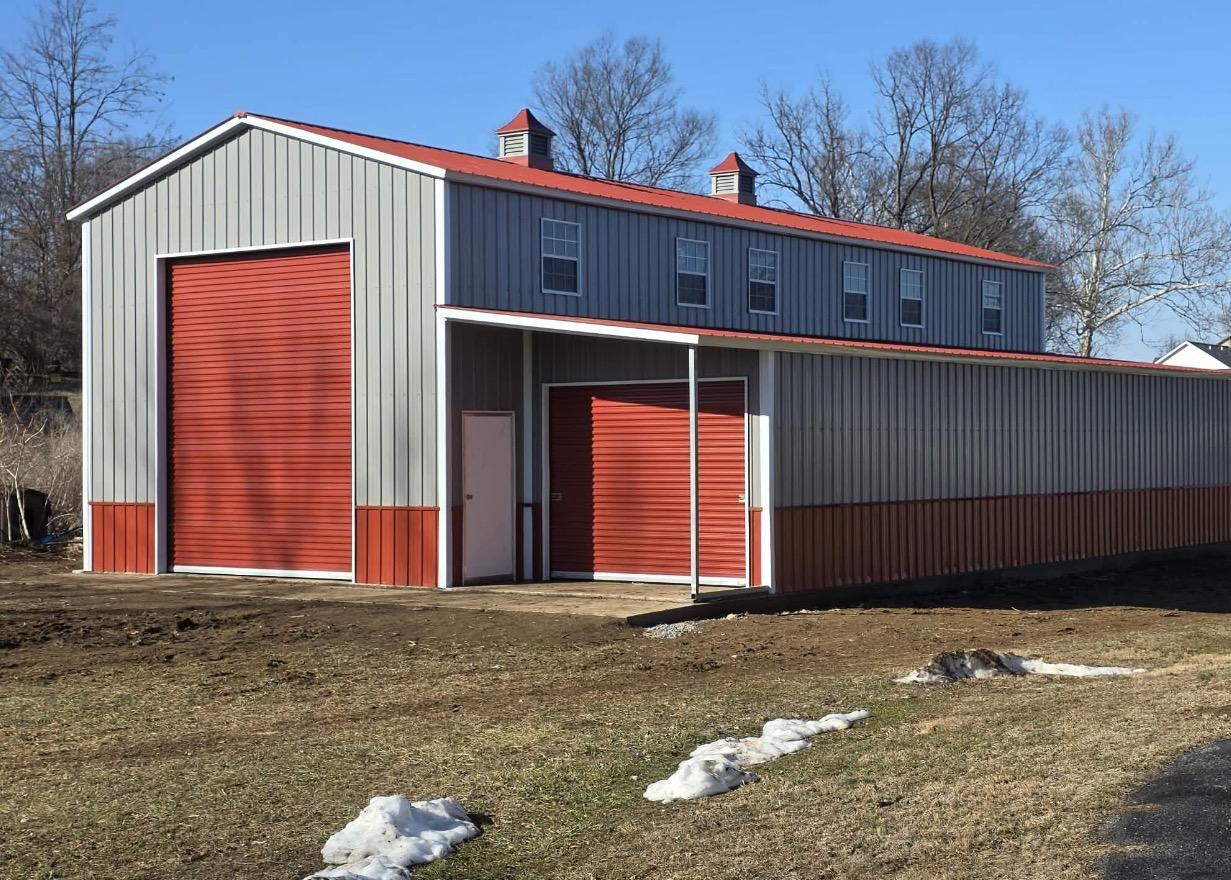
It depends on where in Tennessee you build. The state’s residential building permit does not cover detached garages, sheds or barns that are not used for living space. But many Tennessee counties and cities run their own permit programs, and some of them do require a permit for accessory buildings. Carter County does. Johnson County says it does not currently require a building permit, but still requires septic and electric permits, and new construction there may need a FEMA flood permit. Call your county before you order.
To find your county’s permit office, try our metal building permit finder by county.
TL;DR:
- Tennessee has statewide building standards, including the 2018 International Residential Code for homes.
- Where no local program enforces them, the State Fire Marshal’s Office issues residential permits for one- and two-family homes and townhouses.
- That state permit is not required for detached garages, sheds, barns or other detached structures that are not used for living.
- Your county or city can still require a permit. Carter County requires a building permit for accessory buildings.
- Non-residential farm buildings are exempt from the state standards. Electrical, septic and flood rules can still apply.
Upper East Tennessee is close to our home base in Galax, Virginia, and we build barns, garages and shops there. Here is how permits work in Tennessee and what to ask before you order a metal building.
Who decides
Tennessee law lets the State Fire Marshal set minimum statewide building standards. According to the University of Tennessee’s Municipal Technical Advisory Service (MTAS), the state has adopted the 2018 International Residential Code for homes and the 2012 International Building Code for other buildings, among others. The State Fire Marshal’s Office (SFMO) confirms it enforces the 2018 IRC with a few amendments.
Who enforces those standards depends on where you are:
- Cities and counties with their own codes program issue their own permits and do their own inspections. That is common in towns and many counties.
- Areas without local enforcement fall under the state’s residential permit program, run by the SFMO, for one- and two-family homes and townhouses.
- “Opt-out” areas. A city or county can vote by a two-thirds majority to exempt itself from the statewide standards for one- and two-family homes. The SFMO says owners there can still ask for a state inspection, which can help with lenders that want a certificate of occupancy.
Zoning is a separate question. A county with zoning can have setback, size and land-use rules even when no building permit is needed.
What the state permit covers
| Building | State residential permit? |
|---|---|
| Detached garage, shed, barn or other detached structure, not used for living | Not required under the state program. Your county or city may still require one. |
| Non-residential farm building | Exempt from the statewide building standards, per MTAS. |
| New home, including a barndominium you will live in | Yes, where the state program applies. Otherwise your local codes office handles it. |
| Addition over 30 sq ft to an existing home | Yes, where the state program applies. |
The SFMO also notes that its residential permit is a building permit only. It does not cover grading or fill, flood plain compliance, septic or sewer, electrical or zoning. Those are separate.
The farm building exemption
MTAS lists non-residential farm buildings among the buildings the statewide standards do not apply to. A hay barn, equipment shed or livestock building on a working farm will often fit. Keep two things in mind:
- County rules can still apply. Carter County’s permit handout lists accessory buildings and does not mention a farm exemption, so ask before you build.
- Living space changes everything. A barn with an apartment or a barndominium shell you plan to live in is not a non-residential farm building.
For farm builds, see our barns and ag buildings.
Electrical and flood permits
Wiring is its own permit. The SFMO says its electrical permits are issued at locations throughout most of the state, and some cities and counties run their own electrical inspections instead. Ask your county which applies.
If your lot is near a creek or river, ask about flood rules before you pick a spot. Flood permits often come from a different office than building permits.
Johnson County
Johnson County’s own website says the county “does not currently require a building permit,” and that its only requirements for new structures and additions are a septic permit and an electric permit. The county also says it does not have a zoning department. Septic questions go to the TDEC Johnson City Environmental Field Office at 423-854-5400.
The county’s homepage also notes that FEMA flood permits are applied for in the Property Assessor’s office, at 423-727-7692. If you are building a home or living space, call the SFMO at 615-741-7170 to ask whether the state residential permit applies at your address. Inside the Town of Mountain City, check with the town too. See our Johnson County page.
Carter County
Carter County Planning & Zoning handles residential permits, and its handout is clear: before any new residential or commercial building, addition, accessory building, pool or ground disturbance, the owner must first verify the project meets zoning. Then you bring:
- A property tax card
- A 911 address
- A septic permit, or proof of an existing system
- A driveway connection agreement from the county highway department
- The square footage, number of stories and type of foundation
- A state contractor’s license, if someone other than the homeowner pulls the permit
The county issues a building permit for all residential and commercial buildings and any accessory buildings, plus a stormwater permit for excavation, cut and fill, footers and concrete slabs as required. Starting work before you have every permit doubles the permit fee. Permits are written weekday mornings, 8:00 to 11:00, and the office number is 423-542-1834. Inside Elizabethton city limits, check with the city as well. See our Carter County page.
What a permit office usually wants
- A site plan showing where the building goes and how far it sits from property lines, the road, septic and any creek
- The building’s engineered drawings, showing the wind and snow loads it is certified for
- Foundation details: slab or footers, slab thickness and footer depth
- Square footage and building use
- Separate electrical or plumbing permits if you add them
Setbacks come from zoning, where a county has it. Here is how to check setbacks on your lot.
How certified drawings help
Every building we sell is certified for local wind and snow loads, and engineered drawings are available. That is usually the piece a permit office asks for. More on those ratings: wind and snow load ratings explained.
Tips that save time
- Call your county codes or planning office first and ask: “What do I need to put a [size] metal garage at my address?”
- If you are inside town limits, ask the town, too.
- Ask about flood zones and stormwater permits before you grade.
- If it is a farm building, ask what proof of farm use they want.
- Tell us what the county said. We will match the foundation to it.
See every area we cover on our Tennessee service page. Building across the line? Read Do You Need a Permit for a Metal Building in Virginia?. Every county is different and rules change, so treat this as a starting point, not legal advice.
Building in East Tennessee? Tell us your county and we will help you sort out what the permit office needs before you order.
Call 276-235-1191 for a Free Quote
Ready to price your own? Build & Price Your Building
FAQ
Do I need a permit for a metal garage in Tennessee?
It depends on your county or city. The state residential permit is not required for detached garages that are not used for living, but many local codes offices do require one. Carter County, for example, requires a building permit for accessory buildings.
Does the Tennessee state permit cover barns and carports?
The State Fire Marshal’s Office says a state residential building permit is not required for detached garages, sheds, barns or other detached structures that are not used for living. Local permit, zoning, flood and electrical rules can still apply.
Are farm buildings exempt in Tennessee?
Non-residential farm buildings are exempt from Tennessee’s statewide building standards. Your county may still have its own rules, and wiring, septic and flood permits can still be required, so ask before you build.
Do I need a building permit in Johnson County, TN?
Johnson County says it does not currently require a building permit. It does require septic and electric permits for new structures, and FEMA flood permits are handled in the Property Assessor’s office. Call the county to confirm for your lot.
What does Carter County need for a permit?
Zoning approval first, then a property tax card, a 911 address, a septic permit or proof of an existing system, a driveway connection agreement, the building’s size and foundation type, and a state contractor’s license if a contractor pulls the permit. A stormwater permit may also be required.
Do I need a permit for a barndominium in Tennessee?
Yes, in most cases. A barndominium you live in is a home, not a farm building or detached storage building. Where the state program applies, the State Fire Marshal’s Office issues the residential permit. Otherwise your local codes office does.
Can you help with the permit?
Yes. Every building we sell is certified for local wind and snow loads, and engineered drawings are available, which is usually what a permit office asks for. Tell us what your county needs and we will match the foundation to it.
Sources
- Tennessee State Fire Marshal’s Office: Residential Permits
- Tennessee State Fire Marshal’s Office: Residential Permit FAQs
- Tennessee State Fire Marshal’s Office: Inspections in Opt-Out or Non-Code Jurisdictions
- UT Municipal Technical Advisory Service: Statewide Building Standards
- Tennessee State Fire Marshal’s Office: Electrical Permits
- Johnson County, TN: Newcomer Information and homepage (FEMA flood permits)
- Carter County, TN: Planning & Zoning
- Carter County, TN: Permit Application Requirements
Leave a Reply