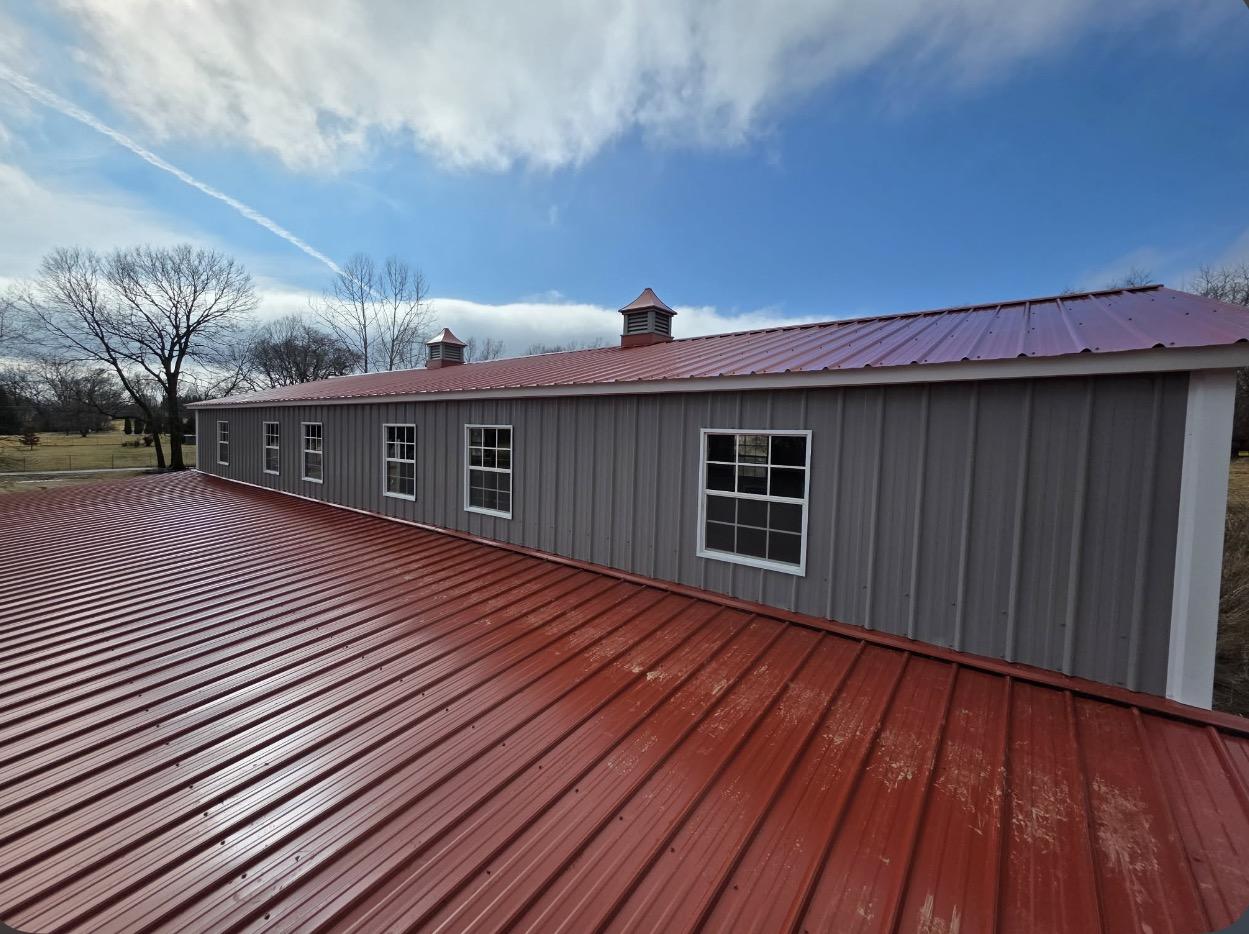
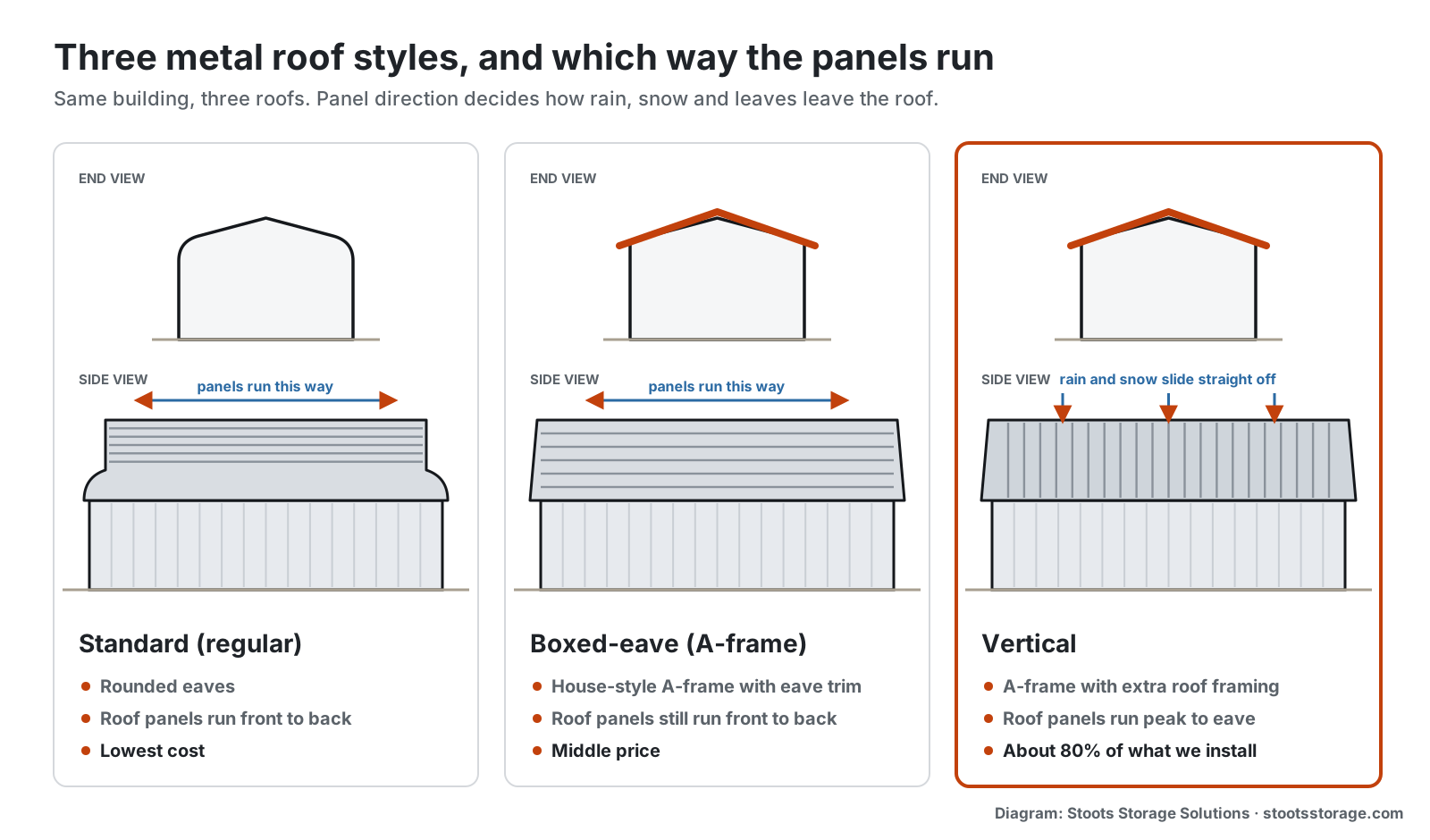
Every metal building comes down to one of three roof styles: vertical, boxed-eave (sometimes called horizontal or A-frame) and standard (the regular rounded style). About 80% of the buildings we install get a vertical roof. Here is why, and when the other two make sense.
Vertical roof
The roof panels run from the peak down to the eaves. Rain, snow and leaves slide straight off instead of sitting in the grooves. That makes it the best choice for anything you want to last, especially enclosed buildings and anything longer than a basic carport.
- Sheds water, snow and debris the best
- Clean, finished look
- Best fit for garages, workshops, barns and anything enclosed
Boxed-eave (horizontal) roof
Boxed-eave roofs have an A-frame shape like a house, but the panels run lengthwise, side to side. It looks sharper than a standard roof and costs less than vertical.
- Home-style look at a lower price than vertical
- A good fit for shorter buildings and areas without much snow
Standard (curved) roof
The standard roof has rounded eaves with panels running lengthwise. It is the most budget-friendly option.
- Lowest cost
- Good for basic carports and simple covers in milder weather
Quick comparison
| Vertical | Boxed-eave | Standard | |
|---|---|---|---|
| Cost | Highest | Middle | Lowest |
| Sheds snow and rain | Best | Good | Fair |
| Best for | Garages, shops, barns, long buildings | Shorter buildings, home-style look | Basic carports, mild climates |
How each roof handles rain, snow and leaves
The difference that matters most is which way the panels run.
- Vertical: the panel ribs run from the peak down to the eave. Water, snow and leaves follow the channels straight off the edge.
- Boxed-eave and standard: the ribs run front to back, across the slope. Water still runs off, but debris and wet snow can hang in the ribs, and on a long building that is a lot of ribs.
On the Blue Ridge plateau around Galax, where we get real snow and ice, that is the main reason most of our customers end up with vertical.
Why a vertical roof costs more
To run panels from peak to eave, the roof needs extra framing, usually hat channels or purlins run across the trusses for the panels to fasten to. More steel, more screws and more trim add cost. That extra framing also stiffens the roof, which is part of why vertical is the usual pick for enclosed buildings.
Which roof for which building
| Building | Our usual pick | Why |
|---|---|---|
| Small open carport, mild weather, tight budget | Standard or boxed-eave | Lowest cost, and a short roof clears fine |
| Long carport or RV cover | Vertical | More roof means more ribs to hold debris and snow |
| Enclosed garage or shop | Vertical | Sheds water best and keeps the roof cleaner and drier |
| Barn, hay or equipment storage | Vertical | Sheds snow and leaves, fewer wet spots over your hay |
| Anywhere with real winter | Vertical | Snow slides off instead of sitting in the ribs |
Roof style and wind and snow ratings
Any of the three can be engineered and certified for your area. The rating comes from the framing, the frame spacing and the anchors, not the roof style alone. What vertical adds is better shedding, so less snow sits on the roof between storms. Make sure the quote lists the wind speed and snow load for your county, whatever roof you pick. More in wind and snow load ratings explained.
Our take
If the building is enclosed, or you get real winter weather, go vertical. The extra cost buys you a roof that stays cleaner and drier for the life of the building. If you just need a simple cover on a budget, the other two are honest options, and we will tell you straight which fits. See all three on our metal buildings page.
Which roof? Answer 3 questions
Based on the comparison tables above. Any of the three can be engineered and certified for your area; the rating comes from the framing, frame spacing and anchors.
Not sure which roof fits your building? Call or text 276-235-1191, or send us a quote request and tell us what the building is for. You can also get a free quote.
Want to see the difference in price? Build & Price Your Building
Common questions
What are boxed eaves on a metal building?
Boxed eaves are what you get with a boxed-eave roof: an A-frame, house-style roof with a peak and squared-off eave edges instead of the rounded edges of a standard roof. The roof panels run lengthwise, side to side. It looks sharper than a standard roof and costs less than a vertical roof. For the names of every part of the frame and trim, see metal building parts explained.
Is boxed-eave the same as “A-frame horizontal”?
Yes. Boxed-eave, A-frame and A-frame horizontal all describe the same house-style roof with panels running front to back.
Can I switch from a standard roof to vertical later?
Not practically. The roof framing is different, so changing styles means a new roof system. Pick the roof you want up front.
Does roof style change my permit?
The building office cares about the engineered drawings and the loads they cover. Roof style is part of the drawings, but a certified building in any style can be permitted if it meets your county’s numbers.
Which roof looks most like a house?
Boxed-eave and vertical both have the A-frame shape. Vertical also has the vertical panel look that a lot of people want on a garage or shop.
Want a straight answer for your site? Call or text 276-235-1191 or send us a quote request. Photos of the spot help a lot.